Learning Persian (Farsi) becomes easier when you start with expressions you can use in everyday conversations. Whether you are planning to visit Iran, communicate with Persian speakers, or simply want to learn a new language, knowing a few essential phrases can help you feel more confident.
In this guide, you will learn 50 basic Persian phrases with English translations and easy pronunciation guides. The phrases cover greetings, polite expressions, introductions, common questions, and everyday situations.
Persian, also known as Farsi, is primarily spoken in Iran. It is written from right to left using the Persian alphabet. If you are new to the language, don’t worry: you can start speaking simple expressions while gradually learning to read and write Persian.
Let’s begin with 50 useful phrases you can start practicing today.
1. Basic Persian Greetings
Greetings are among the first expressions you should learn in any language. These common Persian greetings will help you start conversations naturally.
| Persian | Pronunciation | English |
|---|---|---|
| سلام | Salâm | Hello |
| صبح بخیر | Sobh bekheyr | Good morning |
| عصر بخیر | Asr bekheyr | Good afternoon / Good evening |
| شب بخیر | Shab bekheyr | Good night |
| خداحافظ | Khodâhâfez | Goodbye |
| فعلاً | Felan | Bye for now / See you later |
| حالت چطوره؟ | Hâlet chetore? | How are you? (Informal) |
| حال شما چطوره؟ | Hâl-e shomâ chetore? | How are you? (Polite) |
| خوبم، ممنون | Khubam, mamnun | I’m fine, thank you |
| شما چطورید؟ | Shomâ chetorid? | And how are you? (Polite) |
Learning tip: Formal vs. informal greetings
In everyday Persian conversations, friends often say:
سلام، خوبی؟
Salâm, khubi?
Hi, how are you?
This is a casual and natural way to greet someone you know. When speaking to someone you don’t know well, or in a more formal situation, you can use:
سلام، حال شما چطوره؟
Salâm, hâl-e shomâ chetore?
Hello, how are you?
In Persian, شما (shomâ) is commonly used as the polite form of “you”, while تو (to) is the informal singular form.
2. Polite and Essential Persian Expressions
Polite expressions are useful in almost every conversation. Whether you are meeting someone, asking for help, or shopping, these words will make communication easier.
| Persian | Pronunciation | English |
|---|---|---|
| لطفاً | Lotfan | Please |
| ممنون | Mamnun | Thank you |
| خیلی ممنون | Kheyli mamnun | Thank you very much |
| خواهش میکنم | Khâhesh mikonam | You’re welcome |
| ببخشید | Bebakhshid | Excuse me / Sorry |
| متأسفم | Mote’assefam | I’m sorry |
| بله | Bale | Yes |
| نه | Na | No |
| شاید | Shâyad | Maybe |
| مشکلی نیست | Moshkeli nist | No problem |
Learning tip: When should you use ببخشید?
One of the most useful Persian expressions is:
ببخشید
Bebakhshid
It can mean “Excuse me” or “Sorry”, depending on the situation.
You can use it to get someone’s attention, politely interrupt a conversation, apologize for a mistake, or ask a stranger a question.
For example:
ببخشید، دستشویی کجاست؟
Bebakhshid, dastshuyi kojâst?
Excuse me, where is the bathroom?
3. Introducing Yourself in Persian
Meeting someone who speaks Persian? These expressions will help you introduce yourself, share basic information, and start a conversation.
| Persian | Pronunciation | English |
|---|---|---|
| اسم من … است | Esm-e man … ast | My name is … |
| اسم شما چیه؟ | Esm-e shomâ chiye? | What’s your name? |
| من اهل … هستم | Man ahl-e … hastam | I’m from … |
| من اهل انگلستان هستم | Man ahl-e Engelestân hastam | I’m from England |
| من فارسی یاد میگیرم | Man Fârsi yâd migiram | I’m learning Persian |
| من کمی فارسی صحبت میکنم | Man kami Fârsi sohbat mikonam | I speak a little Persian |
| از آشنایی با شما خوشوقتم | Az âshenâyi bâ shomâ khoshvaghtam | Nice to meet you |
| چند سال دارید؟ | Chand sâl dârid? | How old are you? |
| من … سال دارم | Man … sâl dâram | I’m … years old |
| کجا زندگی میکنید؟ | Kojâ zendegi mikonid? | Where do you live? |
Learning tip: Tell people you’re learning Persian
This is a particularly useful sentence for beginners:
من فارسی یاد میگیرم.
Man Fârsi yâd migiram.
I’m learning Persian.
You can also say:
من کمی فارسی صحبت میکنم.
Man kami Fârsi sohbat mikonam.
I speak a little Persian.
These expressions help people understand your language level and can make it easier to start a simple conversation.
A small grammar note: To say where you are from, use:
من اهل … هستم.
Man ahl-e … hastam.
I’m from …
For example:
من اهل کانادا هستم.
Man ahl-e Kânâdâ hastam.
I’m from Canada.
4. Common Persian Questions
Questions help you understand conversations, ask for information, and find your way around when traveling.
| Persian | Pronunciation | English |
|---|---|---|
| این چیه؟ | In chie? | What is this? |
| اون چیه؟ | Un chie? | What is that? |
| کجا هستید؟ | Kojâ hastid? | Where are you? |
| دستشویی کجاست؟ | Dastshuyi kojâst? | Where is the bathroom? |
| ساعت چنده؟ | Sâ’at chande? | What time is it? |
| قیمتش چنده؟ | Gheymatesh chande? | How much does it cost? |
| چرا؟ | Cherâ? | Why? |
| کی؟ | Ki? | Who? / When? (Depending on context) |
| چی؟ | Chi? | What? |
| میتونید کمکم کنید؟ | Mitunid komakam konid? | Can you help me? (Polite) |
Learning tip: Understand everyday Persian questions
Some Persian questions have informal and formal versions.
For example:
این چیه؟
In chie?
What is this?
This is common in everyday conversation.
A more formal version is:
این چیست؟
In chist?
What is this?
You may see the formal version in textbooks and written Persian, while the informal version is common in everyday speech.
Another useful distinction:
The word کی (ki) can mean “who” or “when”, depending on the sentence.
For example:
کی اومد؟
Ki umad?
Who came?
کی میای؟
Ki miâyi?
When are you coming?
Context helps you understand which meaning is intended.
5. Useful Everyday Persian Phrases
These expressions are especially helpful when you are traveling, shopping, meeting people, or trying to understand a conversation.
| Persian | Pronunciation | English |
|---|---|---|
| نمیفهمم | Nemifahmam | I don’t understand |
| متوجه نمیشوم | Motavajjeh nemishavam | I don’t understand (More formal) |
| لطفاً آهستهتر صحبت کنید | Lotfan âheste-tar sohbat konid | Please speak more slowly |
| دوباره بگید، لطفاً | Dobâre begid, lotfan | Please say it again |
| میدونم | Midunam | I know (Informal) |
| نمیدونم | Nemidunam | I don’t know (Informal) |
| بفرمایید | Befarmâyid | Here you go / Please, go ahead |
| خوشم میاد | Khosham miyâd | I like it |
| گرسنهام | Gorosne-am | I’m hungry |
| خستهام | Khaste-am | I’m tired |
Learning tip: Ask someone to speak more slowly
If a Persian speaker talks too quickly, this phrase can be very helpful:
لطفاً آهستهتر صحبت کنید.
Lotfan âheste-tar sohbat konid.
Please speak more slowly.
You can also ask someone to repeat a sentence:
دوباره بگید، لطفاً.
Dobâre begid, lotfan.
Please say it again.
Both expressions are useful when you are still developing your listening skills.
6. A Short Persian Conversation Using These Phrases
Now that you have learned 50 useful expressions, let’s see how some of them work together in a simple conversation.
Conversation: Meeting Someone for the First Time
| Speaker | Persian | Pronunciation | English |
|---|---|---|---|
| A | سلام، خوبی؟ | Salâm, khubi? | Hi, how are you? |
| B | خوبم، ممنون. شما چطورید؟ | Khubam, mamnun. Shomâ chetorid? | I’m fine, thank you. And you? |
| A | منم خوبم، ممنون. اسم شما چیه؟ | Manam khubam, mamnun. Esm-e shomâ chiye? | I’m fine too, thanks. What’s your name? |
| B | اسم من الکس است. | Esm-e man Alex ast. | My name is Alex. |
| A | از آشنایی با شما خوشوقتم. | Az âshenâyi bâ shomâ khoshvaghtam. | Nice to meet you. |
| B | من هم همینطور. | Man ham hamin-tor. | Nice to meet you too. |
Try reading this conversation aloud. First, use the pronunciation guide. Then try reading the Persian script without looking at the Latin pronunciation.
7. How to Practice These 50 Persian Phrases
Memorizing phrases is a good first step, but using them in real situations is what helps you become a more confident speaker.
Here are five practical ways to practice:
- Learn five phrases a day: Start with greetings and gradually move to introductions, questions, and everyday expressions.
- Practice pronunciation aloud: Read each Persian phrase several times and pay attention to its sounds.
- Listen to native speakers: Try to recognize these expressions in Persian conversations, videos, and podcasts.
- Create short dialogues: Combine the phrases you have learned to introduce yourself, ask questions, or talk about everyday situations.
- Review regularly: Revisit previous phrases instead of trying to memorize all 50 at once.
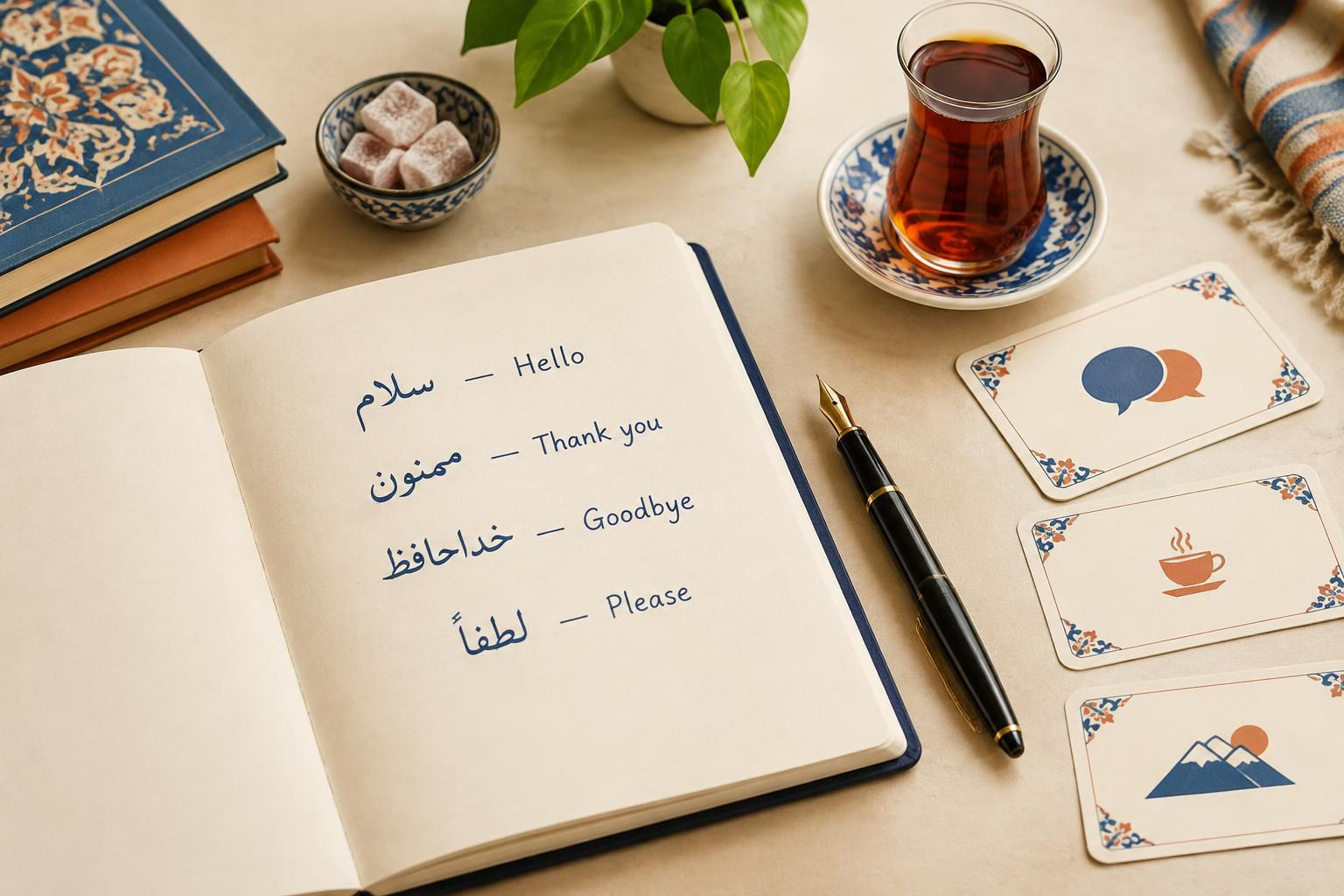
You can also write each expression in a notebook with three columns: Persian spelling, pronunciation, and English meaning.
A Simple 10-Day Practice Plan
If you want to learn all 50 phrases without feeling overwhelmed, try this plan:
| Day | Practice |
|---|---|
| Day 1 | Learn phrases 1–5: Basic greetings |
| Day 2 | Learn phrases 6–10: Greetings and responses |
| Day 3 | Learn phrases 11–15: Polite expressions |
| Day 4 | Learn phrases 16–20: Essential responses |
| Day 5 | Learn phrases 21–25: Introductions |
| Day 6 | Learn phrases 26–30: Personal information |
| Day 7 | Learn phrases 31–35: Common questions |
| Day 8 | Learn phrases 36–40: Asking for information |
| Day 9 | Learn phrases 41–45: Everyday expressions |
| Day 10 | Learn phrases 46–50 and review all 50 |
Try to use at least three phrases in your own sentences every day.
8. What Should You Learn After These 50 Persian Phrases?
Learning these expressions gives you a useful starting point, but it is only the beginning of your Persian-learning journey.
To make further progress, you should gradually develop your reading, listening, vocabulary, and grammar skills.
Here are some useful next steps:
1. Learn the Persian alphabet
Understanding the Persian alphabet will help you read words without depending on Latin pronunciation.
Start with our guide: Learn Farsi Alphabet: A Beginner’s Guide to Persian Letters.
If you want a more focused introduction, read How to Read the Persian Alphabet in 1 Hour.
2. Follow a beginner-friendly learning path
If you are starting from zero, our guide Learn Persian for Beginners: Where Should You Start? explains what to learn first and how to build your skills step by step.
3. Understand how difficult Persian is
Wondering whether Persian is difficult for English speakers? Read Is Persian Hard to Learn? A Realistic Guide for Beginners.
4. Explore different ways to study Farsi
For practical advice on building a consistent learning routine, see Best Way to Learn Farsi: A Practical Guide for Beginners.
5. Learn with structured lessons
You can also explore the Persian language courses at Learnoteach to continue learning with organized lessons and practical explanations.
Final Thoughts: Start Speaking Persian One Phrase at a Time
Learning a new language takes time, but you do not need to know thousands of words before you can start communicating.
These 50 basic Persian phrases give you a practical foundation for greeting people, introducing yourself, asking questions, and handling simple everyday situations.
Start with five phrases a day. Practice saying them aloud, listen to native Persian speakers, and try using what you learn in short conversations.
The more you practice, the more familiar these expressions will become.
Ready to continue learning Persian?
Explore the Learnoteach Persian courses and discover more language-learning resources on the Learnoteach Blog.
You can also follow Learnoteach for more Persian vocabulary, expressions, and learning tips:
Your first Persian conversation can start with just one word: سلام!