Learning a new language can feel overwhelming, especially when you are starting from zero. If you want to learn Persian, also known as Farsi, you may not know whether you should begin with the alphabet, pronunciation, vocabulary, grammar, or conversation.
The good news is that you do not need to learn everything at once.
The most effective way to learn Persian for beginners is to follow a clear path. Start with the sounds and writing system, learn useful everyday words and phrases, build simple sentences, and gradually develop your listening and speaking skills.
In this guide, you will learn exactly where to start, what to study first, which mistakes to avoid, and how to create a practical Persian learning routine.
Why Learn Persian?
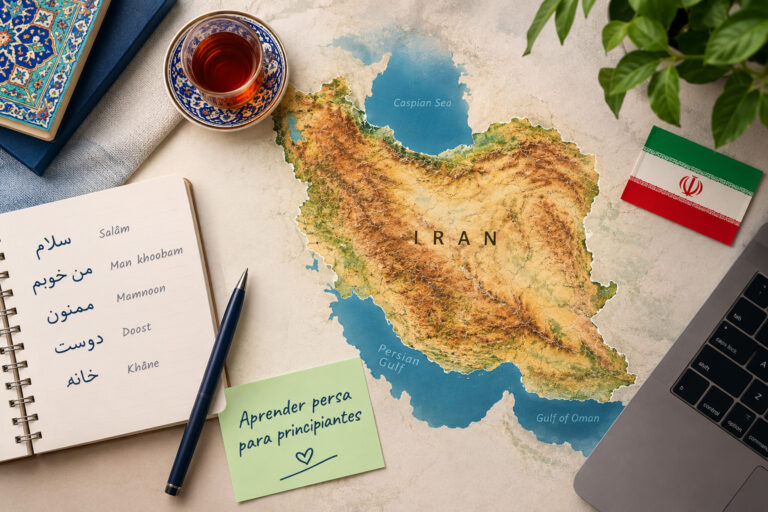
Persian is one of the world’s historically important languages and is spoken primarily in Iran, Afghanistan, and Tajikistan. It is known as Farsi in Iran, Dari in Afghanistan, and Tajik in Tajikistan.
For many learners, Persian is more than just a language. It provides access to Persian literature, history, music, culture, travel, and everyday communication with Persian speakers.
If you are planning to travel to Iran, communicate with Persian-speaking friends or family, study Persian literature, or simply explore a fascinating language, learning basic Farsi can be a rewarding experience.
But where should you begin?
Step 1: Learn the Persian Alphabet
If you are completely new to Persian, learning the alphabet is a good starting point.
Persian uses a modified version of the Arabic script. It is written from right to left, which can initially feel unfamiliar to English speakers.
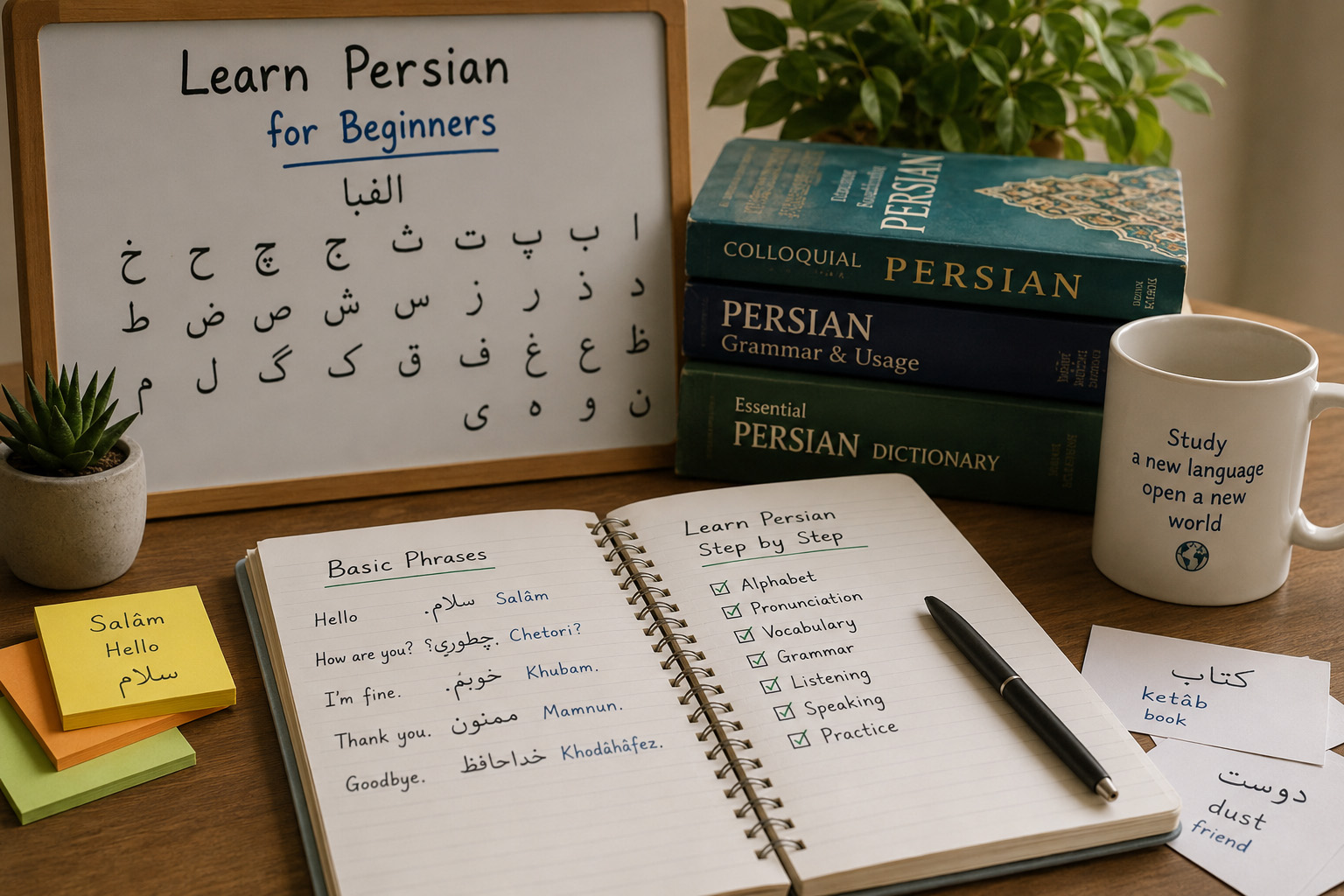
The Persian alphabet has 32 letters.
However, you should not try to memorize all 32 letters in one sitting.
Instead, learn them gradually and pay attention to:
- The shape of each letter
- The sound of each letter
- How letters change shape depending on their position
- Which letters connect to other letters
- How Persian words are written from right to left
For example, the letter ب is pronounced approximately like the English “b” sound.
The important thing at this stage is not to write perfectly. Your first goal should be to recognize letters and understand how the Persian writing system works.
Should You Learn the Alphabet Before Speaking?
Not necessarily.
You can start learning basic spoken Persian phrases while learning the alphabet.
In fact, combining speaking and reading can make the learning process more interesting. You might learn a phrase in spoken Persian and then gradually learn how to recognize and read it.
This approach prevents the alphabet from becoming a boring memorization exercise.
Step 2: Focus on Persian Pronunciation
Pronunciation is one of the most important parts of learning Persian.
Before memorizing hundreds of words, spend some time listening to native speakers and becoming familiar with Persian sounds.
Many Persian sounds are relatively easy for English speakers because Persian pronunciation does not have the same level of complexity found in some other languages.
However, there are sounds that may require practice.
For example, Persian has several sounds represented by different letters that may sound similar to learners.
When learning pronunciation, do not rely only on English transliteration.
Transliteration can be useful at the beginning, but if you depend on it for too long, it can slow down your ability to read Persian.
A better approach is:
- Listen to the word.
- Repeat the word.
- Look at the Persian spelling.
- Repeat it again.
- Use it in a simple sentence.
This helps you connect the sound directly to the Persian word.
Step 3: Learn Useful Persian Words First
One of the biggest mistakes beginners make is trying to memorize long vocabulary lists.
You do not need thousands of words to start communicating.
Instead, focus on high-frequency and useful vocabulary.
Start with categories such as:
Greetings
- Hello — سلام (Salâm)
- Goodbye — خداحافظ (Khodâhâfez)
- Thank you — ممنون (Mamnun)
- Please — لطفاً (Lotfan)
- Yes — بله (Bale)
- No — نه (Na)
Basic Questions
- What? — چی؟ / چه؟ (Chi? / Che?)
- Where? — کجا؟ (Kojâ?)
- Who? — کی؟ (Ki?)
- Why? — چرا؟ (Cherâ?)
- How? — چطور؟ (Chetor?)
Everyday Words
Learn words related to things you encounter every day:
- Food
- Water
- Family
- Home
- Work
- School
- Time
- Money
- Transportation
- Shopping
- Weather
The goal is to make your vocabulary immediately useful.
Step 4: Learn Persian Phrases, Not Just Individual Words
Knowing individual words is useful, but learning complete phrases can help you communicate much faster.
For example, instead of only learning the word خوب (good), learn a complete expression:
خوبم.
Khubam.
“I’m good.”
Instead of memorizing only اسم (name), learn:
اسم من … است.
Esm-e man … ast.
“My name is …”
Learning phrases gives you a basic framework for creating your own sentences.
It also helps you understand how Persian words work together naturally.
For beginners, useful phrases are often more valuable than isolated vocabulary.
Step 5: Understand Basic Persian Sentence Structure
Once you know some vocabulary and phrases, it is time to understand basic Persian grammar.
You do not need to study complicated grammar rules immediately.
Start with the basic sentence structure.
Persian commonly uses a Subject-Object-Verb (SOV) word order.
For example:
من فارسی یاد میگیرم.
Man Fârsi yâd migiram.
Literally:
“I Persian learn.”
Naturally:
“I am learning Persian.”
This is different from the typical English Subject-Verb-Object structure.
Understanding this basic difference will help you recognize Persian sentences more easily.
Start With Simple Sentences
At the beginning, focus on simple structures such as:
- I am …
- You are …
- I have …
- I want …
- I like …
- I don’t know …
- Where is …?
- What is this?
- Can you help me?
These sentence patterns can be reused with many different vocabulary items.
You do not need to master every Persian grammar rule before you start speaking.
Step 6: Learn Persian Pronouns and Essential Verbs
After basic vocabulary and sentence patterns, learn common pronouns and verbs.
Some important Persian pronouns include:
- من — I
- تو — you
- او — he/she
- ما — we
- شما — you (formal/plural)
- آنها — they
Then gradually learn high-frequency verbs such as:
- بودن — to be
- داشتن — to have
- رفتن — to go
- آمدن — to come
- خوردن — to eat
- دیدن — to see
- خواستن — to want
- دانستن — to know
- گفتن — to say
- کردن — to do
You do not need to memorize every tense immediately.
Start with common forms that you can actually use in conversation.
Once you understand the basic patterns, you can expand your grammar naturally.
Step 7: Start Listening to Persian From Day One
Many learners wait until they know enough vocabulary before listening to native speakers.
This is a mistake.
You should start listening to Persian from the beginning.
At first, you may understand almost nothing. That is completely normal.
Your brain needs time to become familiar with:
- The rhythm of Persian
- Word boundaries
- Common sounds
- Intonation
- Natural speaking speed
- Frequently repeated expressions
Begin with short and simple audio.
Listen to the same material multiple times rather than constantly moving to new content.
A useful beginner exercise is:
Listen → Read → Listen again → Repeat
This connects listening, reading, pronunciation, and speaking.
Step 8: Practice Speaking Persian Early
You do not need perfect grammar before speaking.
In fact, waiting until your Persian is “good enough” can make speaking much harder.
Start with very short sentences.
For example:
سلام. خوبی؟
Salâm. Khubi?
“Hello. How are you?”
من خوبم.
Man khubam.
“I’m good.”
اسم من … است.
Esm-e man … ast.
“My name is …”
من فارسی یاد میگیرم.
Man Fârsi yâd migiram.
“I’m learning Persian.”
These sentences may seem simple, but they give you an important first step toward real communication.
Try saying them aloud rather than only reading them.
Step 9: Build a Small Daily Persian Routine
Consistency is more important than studying for several hours once a week.
A beginner can make significant progress with a focused 20–30 minute daily routine.
For example:
A 30-Minute Persian Study Routine
10 minutes — Vocabulary
Review 5–10 useful words or phrases.
5 minutes — Reading
Read a short Persian text and identify familiar words.
5 minutes — Listening
Listen to a short Persian conversation.
5 minutes — Speaking
Repeat phrases aloud and create a few sentences.
5 minutes — Review
Review what you learned earlier.
The exact schedule is not important.
The important thing is to study regularly.
Thirty minutes every day is usually more sustainable than studying for three hours once a week.
Step 10: Learn Persian in Context
Try to learn vocabulary and grammar through situations rather than isolated exercises.
For example, if you are planning to travel to Iran, learn Persian related to:
- Airports
- Hotels
- Restaurants
- Transportation
- Shopping
- Asking for directions
- Meeting people
- Ordering food
- Emergencies
This gives your learning a clear purpose.
Instead of asking, “What Persian words should I memorize?”, ask:
“What Persian do I need for the situation I want to handle?”
This simple change can make your learning much more practical.
How Long Does It Take to Learn Persian?
There is no single answer.
The amount of time required depends on your native language, previous language-learning experience, study routine, goals, and exposure to Persian.
Learning enough Persian to introduce yourself and handle basic situations can happen relatively quickly with consistent practice.
Becoming comfortable with everyday conversations takes longer.
Advanced fluency requires considerably more exposure and practice.
Instead of focusing only on how many months it will take, set smaller goals.
For example:
Goal 1: Learn the Persian alphabet.
Goal 2: Learn 100 essential words and phrases.
Goal 3: Introduce yourself in Persian.
Goal 4: Understand basic conversations.
Goal 5: Hold a short everyday conversation.
Goal 6: Read simple Persian texts.
These smaller milestones make progress easier to see.
Common Mistakes Persian Beginners Should Avoid
1. Trying to Learn Everything at Once
Persian has vocabulary, grammar, pronunciation, writing, and different levels of formality.
You do not need to master everything immediately.
Focus on one step at a time.
2. Memorizing Too Many Words
A vocabulary list with 1,000 words is not necessarily useful if you cannot use those words in sentences.
Learn fewer words and use them frequently.
3. Depending on Transliteration
Transliteration can help beginners pronounce words, but it should not become a permanent replacement for Persian script.
Gradually move from transliteration to reading Persian.
4. Studying Grammar Without Using It
Grammar becomes much easier when you see it in real sentences.
Instead of only memorizing rules, learn examples and practice creating your own sentences.
5. Avoiding Speaking
You will make mistakes.
That is part of learning a language.
The goal of beginner speaking practice is not perfection. The goal is to become comfortable communicating.
What Should You Learn First in Persian?
If you are starting Persian from zero, a practical learning sequence looks like this:
- Persian sounds and pronunciation
- Persian alphabet
- Basic greetings and expressions
- Essential everyday vocabulary
- Personal pronouns
- Basic sentence structure
- Common verbs
- Numbers and time
- Everyday conversations
- Basic grammar
- Listening practice
- Regular speaking practice
You do not have to follow this sequence perfectly.
Some skills should be learned simultaneously.
For example, you can study the alphabet while learning basic phrases and listening to Persian.
Can You Learn Persian Online?
Yes. Online learning can be an effective way to learn Persian, especially when you combine structured lessons with listening and speaking practice.
A good Persian learning program should ideally include:
- Beginner-friendly lessons
- Audio from natural Persian speakers
- Persian script
- Pronunciation practice
- Useful vocabulary
- Grammar explanations
- Conversation examples
- Exercises and repetition
- A clear progression from beginner to intermediate levels
Avoid relying on a single resource.
Use a combination of structured lessons, audio, reading, conversation practice, and real Persian content.
A Simple 30-Day Persian Beginner Plan
If you want a clear starting point, you can use this four-week plan.
Week 1: Get Familiar With Persian
Focus on:
- Persian alphabet
- Basic sounds
- Greetings
- Introducing yourself
- Numbers
- Essential expressions
Do not worry about advanced grammar.
Week 2: Build Your Basic Vocabulary
Learn vocabulary related to:
- Family
- Food
- Home
- Work
- Daily activities
- Time
- Places
Practice using the words in short sentences.
Week 3: Start Building Sentences
Focus on:
- Pronouns
- Common verbs
- Basic sentence structure
- Questions
- Negatives
- Simple everyday conversations
Try to produce your own sentences instead of only repeating examples.
Week 4: Practice Real Communication
Focus on:
- Listening
- Speaking
- Short dialogues
- Reading simple texts
- Reviewing vocabulary
- Using common expressions
By the end of the month, you should have a basic foundation that allows you to continue learning more confidently.
The Best Way to Learn Persian for Beginners
There is no magic shortcut to learning Persian.
The most effective approach is a combination of structured learning, consistent practice, meaningful vocabulary, listening, reading, and speaking.
Do not try to become fluent immediately.
Your first goal should be to build a strong foundation.
Learn how Persian sounds. Understand the alphabet. Memorize useful expressions. Learn basic sentence patterns. Listen to native Persian regularly. Speak even when you make mistakes.
Most importantly, make Persian part of your daily routine.
Even 20–30 minutes of focused practice every day can give you a much stronger foundation than occasional intensive study.
If you are ready to start learning Persian from the beginning, a structured beginner course such as Persian Foundations can give you a clear path through the essential building blocks of the language before you move on to more advanced Persian.
Final Thoughts
Learning Persian for beginners may seem difficult at first, particularly because the writing system is different from English.
But you do not need to understand everything before you begin.
Start small.
Learn the sounds. Learn the alphabet. Learn useful phrases. Build simple sentences. Listen to Persian every day. Practice speaking as early as possible.
The most important thing is to keep moving forward.
You do not need to know thousands of Persian words to start communicating. You only need a useful foundation, regular practice, and the confidence to use what you have learned.
Start with the basics, practice consistently, and let your Persian grow one sentence at a time.