Have you ever seen Persian writing and wondered how people read those beautiful, flowing letters?
If you’re starting to learn Persian, the Persian alphabet may look difficult at first. But there is good news: you don’t need to spend weeks memorizing letters before you can start reading.
With focused practice, you can learn the basics of the Farsi alphabet in about one hour. You won’t become a fluent Persian reader in 60 minutes, of course, but you can learn the letters, recognize common patterns, understand how Persian writing works, and begin reading simple Persian words.
In this beginner-friendly guide, you’ll learn how to read the Persian alphabet in 1 hour, including the 32 Persian letters, their sounds, vowels, connected forms, and some useful Persian words.
Can You Really Learn the Persian Alphabet in 1 Hour?
Yes, you can learn the basics of the Persian alphabet in one hour.
In 60 minutes, a beginner can learn to recognize the 32 Persian letters, understand their basic sounds, read from right to left, identify common letter patterns, and sound out simple Persian words.
However, learning to read Persian comfortably and naturally takes more practice.
Think of your first hour as building the foundation. Once you understand the writing system, improving your Persian reading skills becomes much easier.
What Is the Persian Alphabet?
The Persian alphabet, also called the Farsi alphabet, is the writing system used for modern Persian.
Persian uses a modified form of the Arabic script, but the two writing systems are not exactly the same.
Modern Persian has 32 letters and is written from right to left.
For example:
سلام
This is salâm, meaning hello.
If you’re familiar with English, the biggest change is that your eyes need to move in the opposite direction.
English:
Hello → left to right
Persian:
سلام → right to left
Once you get used to this direction, reading Persian becomes much more natural.
The 32 Letters of the Persian Alphabet
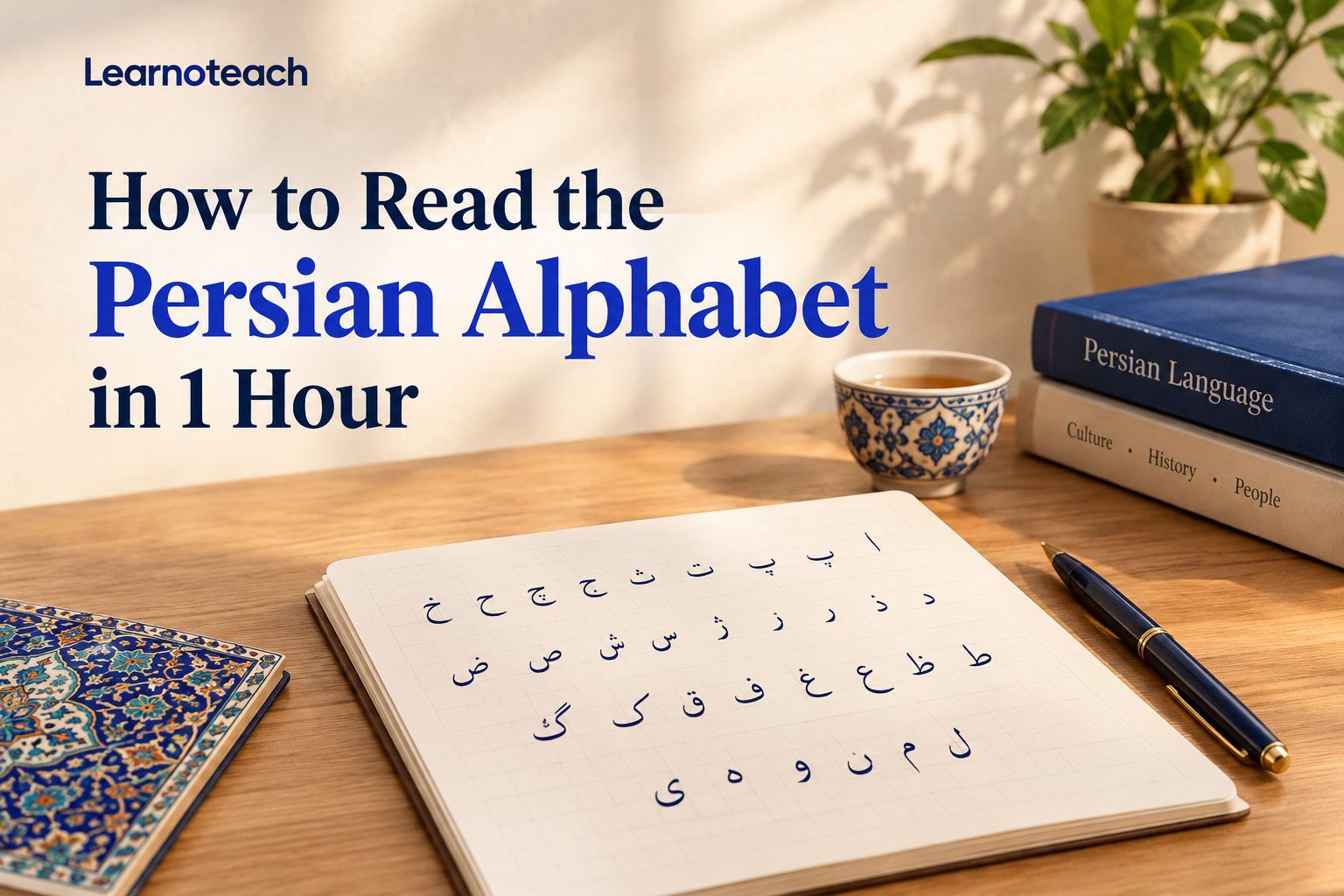
Here is the complete Persian alphabet:
| Letter | Persian Name | Approximate Sound |
|---|---|---|
| ا | Alef | â / a |
| ب | Be | b |
| پ | Pe | p |
| ت | Te | t |
| ث | Se | s |
| ج | Jim | j |
| چ | Che | ch |
| ح | He | h |
| خ | Khe | kh |
| د | Dâl | d |
| ذ | Zâl | z |
| ر | Re | r |
| ز | Ze | z |
| ژ | Zhe | zh |
| س | Sin | s |
| ش | Shin | sh |
| ص | Sâd | s |
| ض | Zâd | z |
| ط | Tâ | t |
| ظ | Zâ | z |
| ع | Ein | a / glottal sound |
| غ | Ghein | gh |
| ف | Fe | f |
| ق | Ghâf | gh |
| ک | Kâf | k |
| گ | Gâf | g |
| ل | Lâm | l |
| م | Mim | m |
| ن | Nun | n |
| و | Vâv | v / u / o |
| ه | He | h |
| ی | Ye | y / i |
Don’t try to memorize this entire table at once.
The fastest way to learn the Persian alphabet is to recognize groups of letters that have similar shapes.
The Persian Alphabet in 6 Easy Steps
Let’s divide your first hour into six simple learning stages.
1. Minutes 0–10: Learn the Reading Direction
Before memorizing letters, understand one fundamental rule:
Persian is read and written from right to left.
Look at this word:
کتاب
It is pronounced ketâb and means book.
You read it starting from the right:
ک → ت → ا → ب
Don’t worry about reading it quickly. For the first few minutes, simply train your eyes to move from right to left.
You can practice with familiar words:
ایران
سلام
کتاب
آب
Even if you don’t know the letters yet, try to get comfortable with the direction.
2. Minutes 10–20: Learn the Easy Persian Letters
Let’s begin with letters whose sounds are relatively familiar to English speakers.
ب — Be
ب = b
Example:
بابا
bâbâ — father / dad
پ — Pe
پ = p
Example:
پول
pul — money
The letter پ is one of the letters that distinguishes Persian from Arabic.
ت — Te
ت = t
Example:
تو
to — you
م — Mim
م = m
Example:
من
man — I / me
ن — Nun
ن = n
Example:
نان
nân — bread
د — Dâl
د = d
Example:
در
dar — door / in
ر — Re
ر = r
The Persian r is usually pronounced with a tap or trill, depending on the speaker.
س — Sin
س = s
Example:
سه
se — three
ش — Shin
ش = sh
Example:
شب
shab — night
ف — Fe
ف = f
Example:
فردا
fardâ — tomorrow
At this point, you already know enough letters to start recognizing some Persian words.
3. Minutes 20–30: Learn Persian Letter Families
One of the best ways to learn the Farsi alphabet quickly is to stop thinking of every letter as a completely different symbol.
Many Persian letters share the same basic shape.
ب، پ، ت، ث
These four letters are related:
- ب = b
- پ = p
- ت = t
- ث = s
Notice how the dots distinguish them.
ب → one dot below
پ → three dots below
ت → two dots above
ث → three dots above
This is much easier to memorize as one family.
ج، چ، ح، خ
Another important family is:
- ج = j
- چ = ch
- ح = h
- خ = kh
Again, the basic shapes are related, while the dots help distinguish the letters.
ر، ز، ژ
These letters are also related:
- ر = r
- ز = z
- ژ = zh
The letter ژ represents the sound found in English words such as measure and vision.
س، ش
These two letters are easy to connect:
- س = s
- ش = sh
The three dots above ش make it easy to recognize.
ک، گ
Another useful pair:
- ک = k
- گ = g
Example:
کتاب
ketâb — book
گل
gol — flower
Learning these families can dramatically reduce the amount of memorization you need.
4. Minutes 30–40: Learn the Persian Sounds That Are New to You
Some Persian sounds may be unfamiliar if English is your first language.
The most important ones for beginners are:
خ، غ، ق، ژ
خ — Khe
The letter خ represents the kh sound.
It is similar to the sound in the Scottish word loch.
Examples:
خوب
khub — good
خانه
khâne — house
غ — Ghein
غ is usually written as gh in English transliteration.
Example:
غذا
ghazâ — food
It is a sound produced toward the back of the mouth.
ق — Ghâf
The letter ق is also commonly transliterated as gh.
In modern Iranian Persian, ق and غ are generally pronounced very similarly.
For reading purposes, don’t worry about mastering the subtle pronunciation difference immediately. First learn to recognize the letters.
Example:
قلب
ghalb — heart
ژ — Zhe
ژ represents the zh sound.
It is similar to the sound in:
- measure
- vision
- pleasure
Example:
ژاپن
Zhâpon — Japan
5. Minutes 40–50: Learn Persian Vowels
Vowels are one of the most important—and sometimes confusing—parts of learning to read Persian.
Persian has three main long vowels:
- آ = â
- و = u / o
- ی = i
Persian also has three short vowel sounds:
- َ = a
- ِ = e
- ُ = o
The important thing to understand is that short vowels are usually not written in normal Persian text.
For example:
من
is pronounced:
man
The short a sound isn’t normally shown.
Another example:
کتاب
is pronounced:
ketâb
The reader has to know the word and understand the likely pronunciation.
This may seem strange if you’re coming from English, where vowels are normally written.
But don’t worry. As your Persian vocabulary grows, these patterns become much easier to recognize.
6. Minutes 50–55: Learn How Persian Letters Connect
This is another major difference between Persian and English.
Many Persian letters connect to neighboring letters.
For example:
کتاب
The individual letters are:
ک + ت + ا + ب
But they appear together as:
کتاب
This means that you need to become comfortable recognizing letters in their connected forms.
Fortunately, you don’t need to memorize dozens of completely different shapes.
The same letter usually keeps recognizable features even when its position changes.
The 7 Persian Letters That Do Not Connect to the Next Letter
There is one particularly useful rule to memorize.
These seven letters do not connect to the letter that comes after them:
ا د ذ ر ز ژ و
You can memorize them as a special group.
For example:
دوست
dust — friend
Understanding these letters will make connected Persian writing much easier to read.
7. Minutes 55–60: Read Your First Persian Words
Now let’s put everything together.
Try reading these words.
Don’t look at the transliteration immediately. First try to sound them out yourself.
سلام
salâm — hello
آب
âb — water
من
man — I / me
تو
to — you
نان
nân — bread
کتاب
ketâb — book
خانه
khâne — house
دوست
dust — friend
خوب
khub — good
ایران
Irân — Iran
Congratulations!
If you can recognize even several of these words after your first hour, you’ve already started learning to read Persian.
Your First Persian Sentence
Now let’s go one step further.
Try reading:
من خوبم.
Man khubam.
It means:
I’m good.
And here is a common greeting:
سلام، خوبی؟
Salâm, khubi?
It means:
Hello, how are you?
You don’t need to understand every grammar rule yet. The goal at this stage is simply to connect Persian letters → sounds → words → meaning.
Why the Persian Alphabet Looks Difficult at First
If you’re a complete beginner, Persian writing can initially look complicated because several things are happening at the same time.
You need to:
- Read from right to left.
- Recognize unfamiliar letters.
- Recognize letters when they are connected.
- Understand that short vowels are often omitted.
- Learn sounds that may not exist in your native language.
The good news is that these challenges become much easier once you understand the system.
The Persian alphabet is not 32 completely unrelated symbols.
There are many patterns, repeated shapes, and predictable rules.
Once you see those patterns, learning becomes much faster.
Persian Alphabet vs. Arabic Alphabet
If you already know Arabic, learning the Persian alphabet will be considerably easier.
Persian uses many of the same letters as Arabic, but Persian adds four letters:
| Persian Letter | Sound |
|---|---|
| پ | p |
| چ | ch |
| ژ | zh |
| گ | g |
These sounds are important in Persian.
For example:
پدر
pedar — father
چای
chây — tea
ژاپن
Zhâpon — Japan
گل
gol — flower
If you’d like to understand the differences in more detail, you can also read our guide to Farsi vs. Arabic: Key Differences.
Common Mistakes Beginners Make
Learning to read Persian can be much easier if you avoid a few common mistakes.
Mistake 1: Trying to Memorize Everything at Once
Don’t spend an hour staring at a list of 32 letters.
Learn them in families and immediately practice them in words.
Mistake 2: Reading Persian from Left to Right
This is probably the most common beginner mistake for English speakers.
Train yourself to start on the right side of the word.
Mistake 3: Depending Completely on Transliteration
Transliteration is useful when you’re starting, but don’t let it become a permanent crutch.
For example, instead of always looking at:
ketâb
try to recognize:
کتاب
as a word.
Mistake 4: Expecting Every Vowel to Be Written
Persian normally doesn’t write short vowels in everyday text.
This is normal.
As you learn more vocabulary, you’ll become better at predicting the pronunciation of words.
Mistake 5: Learning Letter Names Without Their Sounds
Knowing that ش is called shin isn’t enough.
You need to immediately associate it with:
ش → sh
The same applies to every letter.
How to Practice Persian Reading After Your First Hour
Your first hour is only the beginning.
The most effective way to improve is to practice for 10–15 minutes every day.
Start with individual letters.
Then practice:
letters → words → phrases → sentences → short texts
For example:
Stage 1: Letters
م ن س ش
Stage 2: Words
من
شب
سلام
Stage 3: Phrases
سلام، خوبی؟
Stage 4: Sentences
من خوبم.
This gradual approach helps your brain recognize Persian writing automatically rather than translating every letter individually.
A 7-Day Persian Reading Challenge
After your first hour, try this simple seven-day plan.
Day 1 — The Alphabet
Review all 32 Persian letters.
Day 2 — Letter Families
Practice:
ب پ ت ث
ج چ ح خ
ر ز ژ
س ش
ک گ
Day 3 — Vowels
Practice â, a, e, o, u, i and learn common examples.
Day 4 — Connected Letters
Practice reading words where several letters are connected.
Day 5 — Common Words
Learn 30–50 everyday Persian words.
Day 6 — Short Sentences
Read simple Persian sentences without transliteration.
Day 7 — Real Persian Text
Try reading a short Persian paragraph.
Don’t worry if you’re slow.
Accuracy comes before speed.
How Long Does It Take to Read Persian Fluently?
Learning the alphabet is relatively quick. Becoming a comfortable reader takes longer.
The exact amount of time depends on your native language, study habits, vocabulary, and how often you practice.
Someone who practices for 10–15 minutes every day can make noticeable progress much faster than someone who studies for several hours once a month.
If you’re wondering how long the overall process of learning Persian takes, read our guide on How Long Does It Take to Learn Persian?
What Should You Learn After the Persian Alphabet?
Once you can recognize the Persian alphabet, don’t stop there.
Your next goals should be:
- Learn everyday Persian vocabulary.
- Practice Persian pronunciation.
- Learn basic Persian grammar.
- Read simple sentences.
- Listen to native Persian speakers.
- Practice speaking.
- Read short Persian texts.
- Build a useful vocabulary for real-life situations.
If you’re a complete beginner, a structured Persian course for beginners can help you progress much faster than studying random vocabulary and grammar rules.
Start Learning Persian with Learnoteach
Learning the alphabet is one of the most important first steps toward learning Persian.
Once you can recognize:
سلام
as salâm, rather than simply seeing it as a collection of unfamiliar symbols, you’ve crossed an important barrier.
From there, you can start connecting Persian writing with vocabulary, pronunciation, conversation, and culture.
At Learnoteach, you can continue your journey beyond the alphabet with structured Persian lessons designed to help learners develop practical language skills.
Whether your goal is to speak Persian, travel to Iran, understand Persian culture, or communicate with Persian speakers, learning to read the alphabet gives you a strong foundation.
Final Thoughts
Learning the Persian alphabet may look intimidating when you first see Persian writing, but the system is more manageable than it appears.
In just one focused hour, you can learn:
- The 32 Persian letters
- How to read right to left
- Common Persian letter families
- Basic Persian sounds
- Long and short vowels
- How letters connect
- The seven letters that don’t connect to the following letter
- Your first Persian words and sentences
You won’t master Persian reading in one hour—but you’ll have something much more valuable:
a starting point.
Spend a few minutes practicing every day, gradually increase your vocabulary, and start reading real Persian as soon as possible.
Before long, Persian writing will stop looking like a mysterious alphabet and start looking like a language you can actually read.
Frequently Asked Questions About the Persian Alphabet
How many letters are in the Persian alphabet?
The modern Persian alphabet contains 32 letters.
Is Persian difficult to read?
Persian can look difficult at first because it uses a different script and is written from right to left. However, once you learn the letter patterns and connections, reading becomes much easier.
Can I learn the Persian alphabet in one hour?
You can learn the basic letters, sounds, writing direction, and fundamental reading rules in about one hour. Becoming a fluent Persian reader requires regular practice.
Is Persian written from right to left?
Yes. Persian is written and read from right to left.
Is the Persian alphabet the same as Arabic?
No. Persian uses a modified Arabic-based script, but it has differences, including four additional letters: پ، چ، ژ، گ.
What are the extra Persian letters?
The four letters added to the Persian alphabet are:
پ (p), چ (ch), ژ (zh), and گ (g).
Do Persian letters connect?
Most Persian letters can connect to neighboring letters. However, ا، د، ذ، ر، ز، ژ، و do not connect to the letter that follows them.
Are Persian vowels written?
Long vowels are generally represented in writing, while short vowels are usually omitted from normal Persian text. This means beginners need to learn common words and pronunciation patterns.
Ready to Read Persian?
You don’t need to wait until you “know enough Persian” to start reading.
Learn the alphabet. Read your first words. Practice every day. Then build from there.
Your first Persian word could be just one hour away.