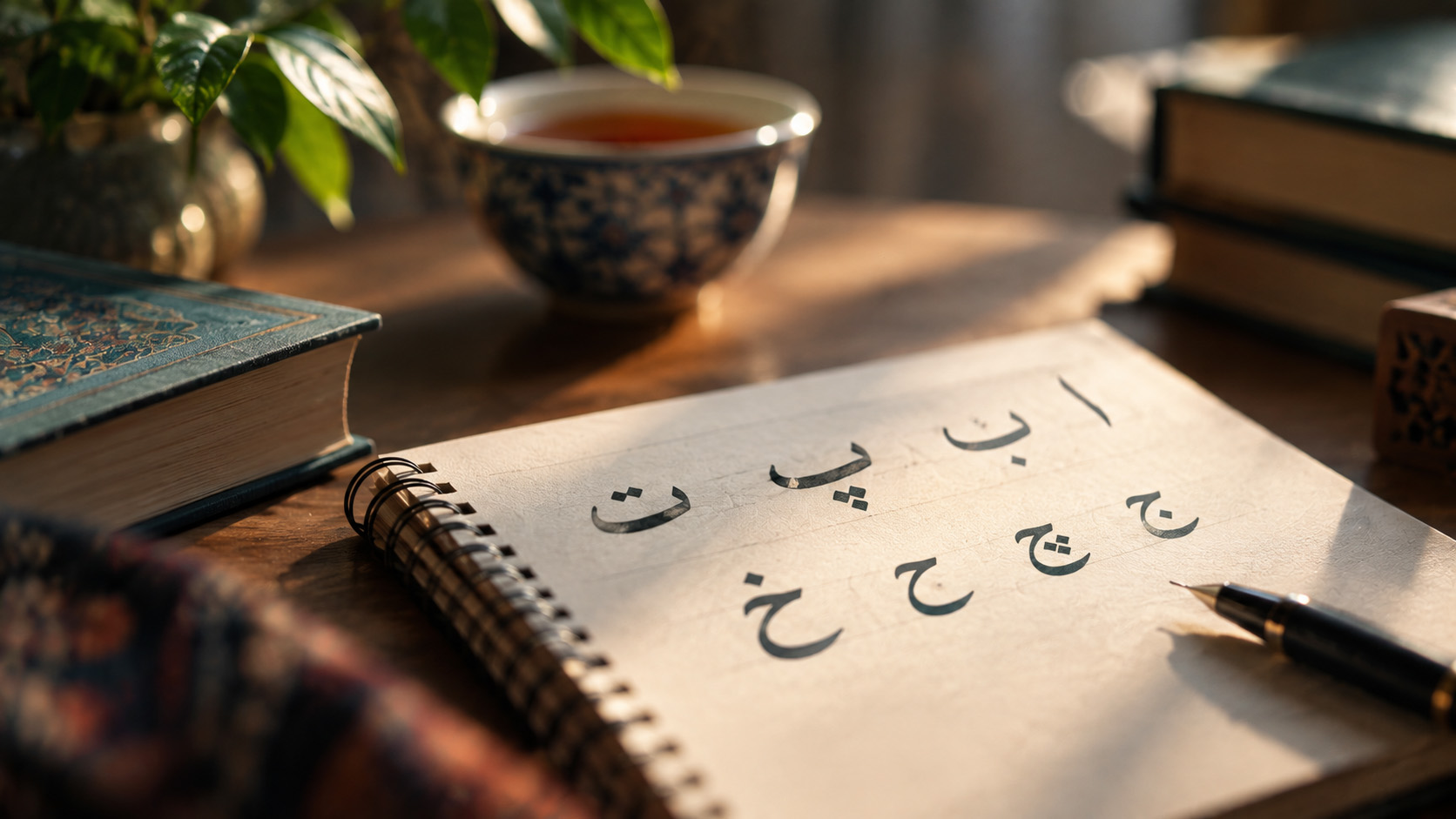
If you want to learn Farsi, one of the best places to start is the Persian alphabet.
At first, Persian letters may look unfamiliar if you are used to the English alphabet. Persian is written from right to left, its letters do not have uppercase and lowercase forms like English, and many letters change their shape depending on where they appear in a word.
The good news is that you do not need to memorize everything at once.
In this guide, you will learn the Farsi alphabet, how Persian letters are pronounced, how they connect to each other, and how to start reading and writing simple Persian words.
By the end, you will have a solid foundation for continuing your Persian-learning journey.
What Is the Farsi Alphabet?
The Farsi alphabet, also called the Persian alphabet, is the writing system used for modern Persian (Farsi).
The Persian alphabet contains 32 letters and is written from right to left. Persian uses a modified form of the Arabic-based script, but the Persian alphabet is not identical to the Arabic alphabet.
One of the most noticeable differences is that Persian has four letters that are not part of the standard Arabic alphabet:
پ — Pe
چ — Che
ژ — Zhe
گ — Gaf
These letters represent sounds that are important in Persian.
Learning these letters is one of the first steps when you want to learn Farsi alphabet and begin reading Persian.
The 32 Letters of the Farsi Alphabet
Here is the complete Persian alphabet with the common Latin transliteration and an approximate English sound.
| Letter | Name | Approximate Sound |
|---|---|---|
| ا | Alef | ā / a |
| ب | Be | b |
| پ | Pe | p |
| ت | Te | t |
| ث | Se | s |
| ج | Jim | j |
| چ | Che | ch |
| ح | He | h |
| خ | Khe | kh |
| د | Dāl | d |
| ذ | Zāl | z |
| ر | Re | r |
| ز | Ze | z |
| ژ | Zhe | zh |
| س | Sin | s |
| ش | Shin | sh |
| ص | Sād | s |
| ض | Zād | z |
| ط | Tā | t |
| ظ | Zā | z |
| ع | Ayn | a / ‘ |
| غ | Ghayn | gh |
| ف | Fe | f |
| ق | Qāf | q / gh |
| ک | Kāf | k |
| گ | Gāf | g |
| ل | Lām | l |
| م | Mim | m |
| ن | Nun | n |
| و | Vāv | v / w / ū |
| ه | He | h |
| ی | Ye | y / i |
Do not worry if some of these letters seem confusing at first.
Several Persian letters have the same pronunciation in modern Persian. Understanding these similarities will make the alphabet much easier to learn.
Persian Letters With the Same Sound
One interesting feature of Persian is that several different letters can represent the same sound.
For example:
س — ص — ث
are generally pronounced s in modern Persian.
Similarly:
ز — ذ — ض — ظ
are generally pronounced z.
And:
ت — ط
are generally pronounced t.
This means that learning Persian pronunciation is not exactly the same as learning Persian spelling.
For example, when you hear a Persian word containing an s sound, you may need to learn its spelling separately because the sound alone does not tell you which letter is used.
This becomes much easier as your Persian vocabulary grows.
The Four Letters Unique to Persian
If you are starting to learn the Persian alphabet, pay special attention to these four letters.
پ — Pe
پ represents the p sound.
For example:
پدر — pedar — father
The sound is similar to the p in the English word “paper.”
چ — Che
چ represents the ch sound.
For example:
چای — chāy — tea
It sounds like the ch in “chair.”
ژ — Zhe
ژ represents the zh sound.
This sound is similar to the sound in the middle of the English word “measure.”
For example:
مژه — mozheh — eyelash
گ — Gaf
گ represents the hard g sound.
For example:
گل — gol — flower
It sounds like the g in “go.”
These four letters are particularly useful because they immediately help beginners distinguish Persian writing from Arabic writing.
Persian Is Written From Right to Left
If English is your first language, the direction of Persian writing may be one of the biggest differences you notice.
English is written:
Left → Right
Persian is written:
Right → Left
For example:
من فارسی یاد میگیرم
means:
I am learning Persian.
When you first start learning Farsi, reading from right to left may feel unusual. With regular practice, however, your eyes will gradually become comfortable with the direction.
Persian numerals are generally written from left to right, even when they appear within right-to-left Persian text.
Do Persian Letters Change Shape?
Yes.
Many Persian letters change their shape depending on their position within a word.
A letter can have:
-
An isolated form
-
An initial form
-
A medial form
-
A final form
For example, the letter ب can look different when it appears alone and when it connects to other letters.
The important thing to remember is that these are not different letters.
They are simply different forms of the same letter.
This is one of the most important concepts to understand when you learn Farsi letters.
Instead of memorizing every connected form as a separate symbol, first learn the basic letter and then learn how it behaves when it connects to other letters.
The Seven Persian Letters That Do Not Connect to the Following Letter
There are seven important Persian letters that do not connect to the letter that comes after them:
ا د ذ ر ز ژ و
A simple way to memorize them is to practice this sequence:
Alef – Dāl – Zāl – Re – Ze – Zhe – Vāv
These letters can affect the visual appearance of Persian words because they create a break in the connection between letters.
Understanding this rule can make Persian handwriting and printed text much easier to read.
Persian Vowels: Why Reading Can Be Difficult
Persian has vowel sounds, but short vowels are often not written explicitly in normal Persian text.
This can be confusing for beginners.
For example:
پدر
is pronounced:
pedar
But the short vowel sounds are not represented by separate full letters in the ordinary spelling.
Persian uses vowel marks called diacritics when pronunciation needs to be indicated, especially in educational materials, dictionaries, children’s books, or texts where pronunciation needs to be clarified.
Long vowel sounds are represented differently and can involve letters such as:
ا، و، ی
This is one reason why learning the Persian alphabet should not be separated completely from learning vocabulary.
When you learn a word, try to learn three things together:
The written form + the pronunciation + the meaning
For example:
آب — āb — water
This approach gradually teaches your brain how Persian writing represents sounds.
How to Learn the Farsi Alphabet Faster
You do not need to memorize all 32 letters in one day.
A better approach is to learn the alphabet gradually and practice it in real words.
1. Learn the Shape and Sound Together
When you learn a new Persian letter, connect its visual shape to its sound.
For example:
م → m
Look at the letter, say the sound, and write it several times.
This creates a stronger connection than simply looking at a list of letters.
2. Learn Similar Letters Together
Some Persian letters have very similar shapes.
For example:
ب — پ — ت — ث
have related shapes, but their dots distinguish them.
Learning these letters as a group can make them easier to remember.
The same approach works for other related letter groups.
3. Practice With Real Persian Words
Do not spend all your time memorizing isolated letters.
As soon as you know a few letters, start looking at simple Persian words.
For example:
آب — āb — water
بابا — bābā — dad
مادر — mādar — mother
پدر — pedar — father
Reading actual words helps you understand how individual letters work together.
4. Practice Writing by Hand
Reading is only one part of learning the alphabet.
Writing Persian letters by hand helps you remember their shapes and understand how letters connect.
Start with isolated letters and gradually practice writing complete words.
You do not need beautiful Persian calligraphy.
Your first goal is simply to write the letters clearly and recognize them when you see them.
5. Read Persian Every Day
Consistency is more important than long study sessions.
Even five to ten minutes of Persian reading every day can help you become more familiar with the alphabet.
Try reading:
-
Simple Persian words
-
Names
-
Short sentences
-
Beginner dialogues
-
Children’s content
-
Persian signs
-
Short social media captions
The more often you see Persian letters, the less unfamiliar they will become.
A 7-Day Plan to Learn the Persian Alphabet
If you are starting from zero, try this simple seven-day approach.
Day 1: Learn Your First Letters
Learn a small group of basic Persian letters.
Focus on their shapes and sounds rather than speed.
Day 2: Add More Letters
Learn another small group and review the letters from Day 1.
Day 3: Learn Similar Letter Groups
Practice groups such as:
ب — پ — ت — ث
Pay attention to the dots.
Day 4: Practice Connected Letters
Start looking at how letters change when they appear at the beginning, middle, or end of words.
Day 5: Learn the Non-Connecting Letters
Practice:
ا — د — ذ — ر — ز — ژ — و
Try recognizing them inside Persian words.
Day 6: Read Simple Words
Use the letters you have learned to read short Persian words.
Do not worry if you cannot understand every word yet.
Focus on recognizing the letters and sounding out the word.
Day 7: Review and Write
Review the alphabet and write several simple Persian words.
Then try reading them without looking at the transliteration.
This seven-day plan is a starting point, not a deadline. Some learners will need more time, while others may move faster.
Farsi Alphabet vs. English Alphabet
Understanding the differences between English and Persian can make learning easier.
| Feature | English | Persian |
|---|---|---|
| Number of letters | 26 | 32 |
| Writing direction | Left to right | Right to left |
| Uppercase/lowercase | Yes | No |
| Connected letters | Limited | Many letters connect |
| Letter shapes | Mostly fixed | Can change by position |
| Short vowels | Usually represented | Often not written |
The goal is not to make Persian work exactly like English.
Instead, learn the rules of the Persian writing system as its own system.
Once you stop trying to read Persian letters as if they were English letters, the writing system becomes much easier to understand.
Common Mistakes When Learning the Farsi Alphabet
Beginners often make a few predictable mistakes.
Trying to Memorize Everything at Once
Thirty-two letters may look like a lot, but learning them in small groups makes the process much easier.
Ignoring Letter Connections
Knowing an isolated letter is not enough.
You also need to recognize how that letter looks when it appears inside a word.
Focusing Only on Transliteration
Latin transliteration is useful in the beginning, but you should gradually move away from it.
If you always read Persian through Latin letters, you may delay developing the ability to recognize Persian words directly.
Expecting Every Letter to Have One Sound
Some Persian letters share the same pronunciation.
Learning spelling and pronunciation together will help you avoid confusion.
Practicing Only Once
Learning the alphabet requires repetition.
Short, regular practice is usually more useful than studying for several hours once and then stopping for a week.
What Should You Learn After the Farsi Alphabet?
Learning the alphabet is only the beginning of learning Persian.
Once you can recognize Persian letters, the next step is to build your vocabulary and learn useful expressions, pronunciation, grammar, and everyday conversation.
You can continue your learning journey through our Persian courses, where you can move beyond individual letters and start learning Persian in a more structured way.
If you prefer learning with a teacher, you can also practice Persian through online Persian classes with Mojgan Jafari.
And if you want to explore more Persian-language learning resources, Iranian culture, history, vocabulary, and useful expressions, visit the Learnoteach blog.
Start Learning Persian Today
The Persian alphabet may look unfamiliar at first, but it becomes much easier once you understand its patterns.
Start by learning a few letters at a time.
Practice their sounds.
Write them by hand.
Read simple Persian words.
Then gradually move from individual letters to words, sentences, and conversations.
The most important thing is not how quickly you memorize the alphabet. It is how consistently you use it.
Once you can recognize Persian letters, you have taken an important first step toward reading, writing, and understanding Farsi.
Frequently Asked Questions About the Farsi Alphabet
How many letters are in the Farsi alphabet?
The Farsi alphabet has 32 letters.
Is the Farsi alphabet the same as the Arabic alphabet?
No. Persian uses an Arabic-based writing system, but the Persian alphabet has differences, including four additional letters: پ، چ، ژ، گ.
Is Farsi written from right to left?
Yes. Persian is normally written from right to left.
What are the four letters unique to Persian?
The four letters commonly identified as additions to the Arabic-based script used for Persian are:
پ — چ — ژ — گ
They represent the p, ch, zh, and g sounds.
Does Persian have uppercase and lowercase letters?
No. Persian does not use uppercase and lowercase letters in the same way English does.
Many Persian letters instead have different forms depending on their position in a word.
Why do Persian letters change shape?
Many Persian letters connect to neighboring letters. Their shape can therefore change depending on whether they appear alone or at the beginning, middle, or end of a word.
What are the Persian letters that do not connect to the following letter?
The seven commonly taught non-connecting letters are:
ا د ذ ر ز ژ و
Is the Farsi alphabet difficult to learn?
It can look unfamiliar to beginners, especially if you are used to the Latin alphabet. However, learning the letters in groups and practicing them in real words can make the process much easier.
What should I learn after the Persian alphabet?
After learning the alphabet, focus on basic vocabulary, pronunciation, reading, writing, everyday expressions, and conversation.
The goal is to move from recognizing individual letters to understanding and using real Persian.
Can I learn Farsi without learning the alphabet?
You can learn some spoken Persian without learning to read, but learning the alphabet gives you access to written Persian and makes it easier to read, spell, and study the language independently.