Introduction
Learning to read Persian (Farsi) may seem challenging at first, especially if you’re unfamiliar with the Persian alphabet or right-to-left writing. However, once you understand how Persian letters work, recognize their different shapes, and learn a few basic reading rules, you can start reading simple Persian words and sentences sooner than you might expect.
Whether you’re learning Persian for travel, family, cultural connections, or personal interest, developing your reading skills is an important step toward understanding the language more deeply.
At Learnoteach, we help learners explore Persian through practical, accessible learning resources designed to make the language easier to understand and use.
In this beginner’s guide, you’ll learn how to read Persian from scratch, understand the alphabet, recognize letters in different forms, read basic words, and develop a practical routine for improving your Persian reading skills.
1. Understand How Persian Writing Works
Before learning individual letters, it’s important to understand how Persian writing works.
Persian, also known as Farsi, is written from right to left. This means you start reading from the right side of a line and move toward the left.
For example:
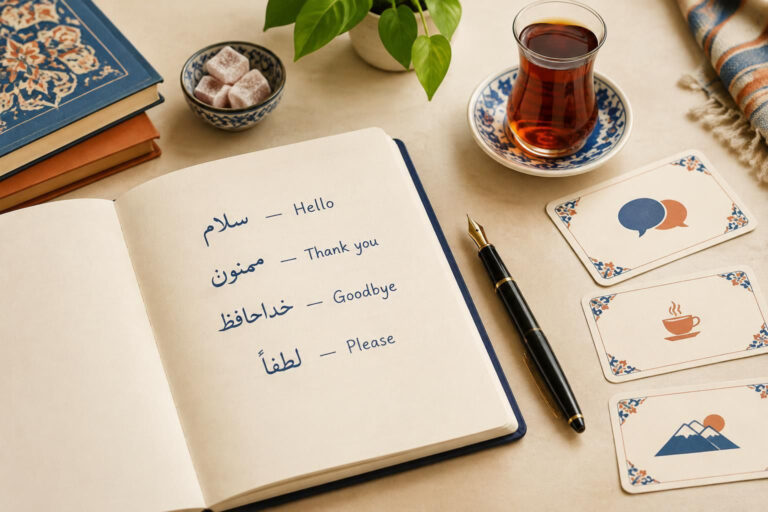
سلام
This word is read from right to left and means Hello.
Persian uses a writing system based on the Arabic script, but it has its own additional letters and distinct linguistic characteristics.
Here are a few important things to know about Persian writing:
- Persian is written from right to left.
- Most Persian letters connect to neighboring letters.
- Letters can have different shapes depending on their position in a word.
- Short vowels are generally not written in everyday Persian texts.
- Persian has 32 letters in its alphabet.
Don’t worry if these rules seem unfamiliar. They become much easier with regular practice.
2. Learn the Persian Alphabet
The Persian alphabet is the foundation of reading Farsi. Learning to recognize the letters is the first major step toward reading words, sentences, and eventually complete texts.
Persian has 32 letters:
| Letter | Name | Approximate sound |
|---|---|---|
| ا | Alef | A / long vowel carrier |
| ب | Be | B |
| پ | Pe | P |
| ت | Te | T |
| ث | Se | S |
| ج | Jim | J |
| چ | Che | Ch |
| ح | He | H |
| خ | Khe | Kh |
| د | Dal | D |
| ذ | Zal | Z |
| ر | Re | R |
| ز | Ze | Z |
| ژ | Zhe | Zh |
| س | Sin | S |
| ش | Shin | Sh |
| ص | Sad | S |
| ض | Zad | Z |
| ط | Ta | T |
| ظ | Za | Z |
| ع | Ain | A / throat sound |
| غ | Gheyn | Gh |
| ف | Fe | F |
| ق | Qaf | Gh / Q |
| ک | Kaf | K |
| گ | Gaf | G |
| ل | Lam | L |
| م | Mim | M |
| ن | Nun | N |
| و | Vav | V / O / U |
| ه | He | H |
| ی | Ye | Y / I |
Some Persian letters represent sounds that may be unfamiliar to English speakers, such as خ (Kh), غ (Gh), and ژ (Zh).
A few letters also share similar sounds. For example, several letters represent the sound of Z, while others represent S. These differences are important for spelling but don’t necessarily make reading harder.
If you want to learn the letters in more detail, start by studying the Persian alphabet and practicing their pronunciation and recognition.
3. Learn the Different Shapes of Persian Letters
One of the most important things to understand when learning to read Persian is that many letters change their appearance depending on where they appear in a word.
A letter may have:
- An isolated form
- An initial form
- A medial form
- A final form
For example, the letter ب (Be) can appear in different forms:
| Position | Form |
|---|---|
| Isolated | ب |
| Initial | بـ |
| Medial | ـبـ |
| Final | ـب |
These forms all represent the same letter and sound.
When letters connect, their appearance changes. This is why beginners sometimes struggle to recognize letters in actual words even after learning the alphabet.
The best way to overcome this challenge is to practice reading complete words rather than memorizing isolated letters alone.
Letters that don’t connect to the following letter
Six Persian letters do not connect to the letter that follows them:
ا، د، ذ، ر، ز، ژ
These letters can connect to the preceding letter, but they break the connection with the next letter.
For example, when one of these letters appears in a word, you may notice a small visual gap between it and the next letter.
Understanding this rule makes Persian words much easier to recognize.
4. Understand Persian Vowels
Vowels are another important part of learning how to read Persian.
Persian has three short vowels and three long vowels.
Short vowels
The short vowels are:
- A — similar to the short sound in some English words
- E — similar to the vowel in bed
- O — similar to the vowel in hot, depending on accent
In Persian writing, short vowels are usually represented by small marks above or below letters. However, these marks are generally omitted from everyday texts.
This means beginners often need to learn the pronunciation of words through context, vocabulary, and listening practice.
Long vowels
Persian has three commonly recognized long vowels:
- آ — long A
- و — long U
- ی — long I
These vowels are often represented by actual letters in written Persian.
For example:
- آب — water
- دوست — friend
- ایران — Iran
Learning the relationship between written letters and spoken sounds will help you gradually become more comfortable reading Persian without vowel markings.
5. Start Reading Simple Persian Words
Once you recognize the alphabet and understand how letters connect, you can begin reading simple Persian words.
Start with familiar and frequently used vocabulary.
| Persian | Transliteration | English |
|---|---|---|
| سلام | Salam | Hello |
| خانه | Khane | House |
| کتاب | Ketab | Book |
| آب | Ab | Water |
| مادر | Madar | Mother |
| پدر | Pedar | Father |
| دوست | Doost | Friend |
| نان | Nan | Bread |
| خوب | Khoob | Good |
| ایران | Iran | Iran |
Try to recognize the letters before looking at the transliteration.
Instead of relying on English pronunciation guides every time, gradually train your brain to recognize Persian words directly.
This process helps you develop more natural reading skills.
6. Practice Reading Simple Persian Sentences
Reading individual words is a good beginning, but sentences help you understand how Persian works in real communication.
Here are some simple Persian sentences:
| Persian | Transliteration | English |
|---|---|---|
| من خوب هستم. | Man khoob hastam. | I am fine. |
| این کتاب است. | In ketab ast. | This is a book. |
| من آب میخواهم. | Man ab mikham. | I want water. |
| او دوست من است. | Oo doost-e man ast. | He/She is my friend. |
| خانه من بزرگ است. | Khane-ye man bozorg ast. | My house is big. |
When practicing, follow these steps:
- Read the sentence from right to left.
- Identify the letters and familiar words.
- Try to understand the sentence without translating every individual letter.
- Listen to the sentence if audio is available.
- Read it aloud several times.
Reading aloud can help connect visual recognition with pronunciation and listening comprehension.
7. Common Challenges When Learning to Read Persian
Most beginners experience a few predictable challenges when learning to read Persian.
Recognizing connected letters
Letters often look different when connected to other letters. This can make words difficult to recognize at first.
Solution: Practice with common words and short sentences instead of focusing only on the alphabet.
Reading without short vowels
Most everyday Persian texts don’t include short vowel markings.
Solution: Build vocabulary and practice reading words in context. Listening to native speakers can also help you identify unfamiliar words.
Confusing letters with similar sounds
Persian contains letters that share similar pronunciations, including several letters representing S, Z, and T sounds.
Solution: Learn the spelling of common words and pay attention to how letters appear in different vocabulary.
Reading too slowly
Beginners often read letter by letter instead of recognizing entire words.
Solution: Practice reading short texts every day. Repetition helps you recognize familiar words more quickly.
8. How to Practice Reading Persian Every Day
You don’t need hours of study to improve your Persian reading skills. A short, consistent routine can be much more effective than occasional long study sessions.
Here is a simple 15-minute daily routine.
| Time | Activity |
|---|---|
| 3 minutes | Review Persian letters |
| 4 minutes | Read 5–10 simple words |
| 4 minutes | Read short Persian sentences |
| 2 minutes | Listen to Persian audio |
| 2 minutes | Read aloud and review mistakes |
Try to follow this routine for several weeks.
As your skills improve, replace simple words and sentences with short paragraphs, dialogues, and beginner-level stories.
You can also explore structured Persian language courses to combine reading practice with vocabulary, grammar, speaking, and listening.
9. How Long Does It Take to Learn to Read Persian?
The time required to learn Persian reading depends on your learning habits, previous language experience, and the amount of practice you do.
Here is an illustrative timeline for a beginner who practices regularly:
| Practice period | Possible progress |
|---|---|
| First few days | Recognizing some Persian letters |
| 1–2 weeks | Reading familiar simple words |
| 3–4 weeks | Reading basic sentences with some hesitation |
| 1–2 months | Reading beginner-level texts with increasing confidence |
| Several months | Developing greater fluency with familiar vocabulary and simple texts |
These are approximate milestones, not guaranteed results. Some learners progress faster, while others need more time.
The important thing is to practice consistently and gradually increase the difficulty of the material.
10. Reading Persian Is Only the Beginning
Learning to read Persian gives you access to a much larger world of language, culture, conversations, stories, and everyday communication.
However, reading alone isn’t enough if your goal is to communicate confidently.
You also need to develop:
- Speaking skills
- Listening comprehension
- Vocabulary
- Grammar
- Pronunciation
- Everyday conversational skills
Combining these skills helps you understand Persian more naturally and use it in real-life situations.
If you’re ready to learn Persian systematically, the Persian Foundations course can help you build a stronger foundation and progress beyond individual words and reading exercises.
11. Continue Practicing Persian with Learnoteach
Learning a language is easier when you regularly expose yourself to new words, expressions, pronunciation, and everyday conversations.
You can continue practicing Persian and discovering learning resources through our social channels:
- Instagram — Discover Persian learning tips, vocabulary, and useful expressions.
- TikTok — Practice with short, engaging Persian language content.
- YouTube — Explore Persian learning videos and educational content.
You can also explore more Persian learning articles to continue improving your language skills.
Frequently Asked Questions
Is Persian difficult to read for beginners?
Persian reading can feel challenging at first because the alphabet is unfamiliar, letters change shape depending on their position, and short vowels are usually omitted. However, with regular practice, most beginners can gradually learn to recognize letters, words, and simple sentences.
Can I learn to read Persian without learning to speak it?
Yes. You can learn to recognize Persian letters, read words, and understand written sentences without first developing speaking skills. However, combining reading with listening and speaking practice can improve your overall language learning experience.
How many letters are in the Persian alphabet?
The Persian alphabet has 32 letters. It includes several letters that aren’t found in the standard Arabic alphabet, including پ, چ, ژ, and گ.
Is Persian written from right to left?
Yes. Persian is written and read from right to left, although numbers generally follow left-to-right conventions.
What is the best way to learn Persian reading?
The best approach is to learn the alphabet, understand letter connections, practice common words, read simple sentences, and gradually move toward longer texts. Consistent daily practice and listening to Persian pronunciation can make the process easier.
Conclusion
Learning how to read Persian doesn’t have to be overwhelming. By understanding the alphabet, recognizing connected letters, learning vowel patterns, and practicing simple words and sentences, you can gradually develop the skills needed to read Farsi.
Start small, practice every day, and don’t worry about reading perfectly at the beginning. Every word you recognize and every sentence you understand brings you one step closer to becoming a confident Persian learner.
With consistency, patience, and the right learning resources, reading Persian can become a rewarding part of your language-learning journey.