Learning a new language can open the door to a new culture, new friendships, and completely different ways of seeing the world. If you want to learn Farsi, also known as Persian, you may be wondering what the best way to learn Farsi really is.
The good news is that you do not need to become an expert in grammar or memorize thousands of words before you can start speaking. With the right approach, you can build useful Farsi skills step by step and begin communicating from the very beginning.
In this guide, we will look at the most effective ways to learn Farsi, including speaking, listening, vocabulary, reading, writing, and using real Persian content.
If you are completely new to Persian, you can also start with the beginner resources and lessons available on Learnoteach.
Why Learn Farsi?
Farsi, or Persian, is primarily spoken in Iran, Afghanistan, and Tajikistan, with Iranian Persian, Dari, and Tajik representing different varieties of the Persian language.
For learners interested in Iran, learning Farsi can be especially useful. Even a basic knowledge of the language can make traveling easier and help you communicate with Persian speakers more naturally.
Learning Farsi can also help you understand Persian culture, literature, music, movies, food, and everyday life from a different perspective.
If you are interested in Iranian culture as well as the language, the Learnoteach Blog includes articles about Persian language, Iranian culture, history, and travel.
What Is the Best Way to Learn Farsi?
The best way to learn Farsi is not to rely on one method alone. A combination of structured lessons, regular listening, vocabulary practice, and real conversations can give you a more complete learning experience.
Instead of spending months studying grammar before speaking, try to develop several skills at the same time:
- Learn useful everyday vocabulary.
- Practice basic sentences.
- Listen to native Farsi speakers.
- Speak from the beginning.
- Learn the Persian alphabet gradually.
- Read simple Persian texts.
- Review what you learn regularly.
- Use Farsi in real-life situations.
The most important factor is consistency. Studying Farsi for 20–30 minutes every day can be easier to maintain than studying for several hours only once a week.
1. Start With Useful Farsi Phrases
If you are a complete beginner, one of the easiest ways to start learning Farsi is by learning common expressions instead of isolated vocabulary.
For example, you can begin with phrases such as:
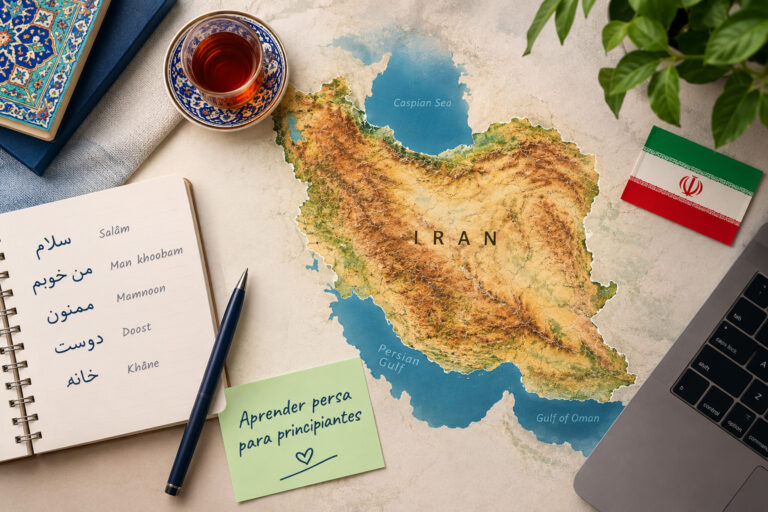
- Salam — Hello
- Khubi? — How are you?
- Mamnoon — Thank you
- Lotfan — Please
- Bale — Yes
- Na — No
- Khodahafez — Goodbye
- Esmet chie? — What is your name?
- Man … hastam — I am …
Learning complete phrases gives you a practical foundation and helps you understand how words work together in real communication.
If you prefer learning through a structured program, you can explore the Learnoteach Persian and Farsi courses and choose a course based on your level and goals.
2. Learn Farsi Pronunciation Early
Pronunciation is an important part of learning any language.
When you learn Farsi, do not focus only on how words are written. Listen to native speakers and try to imitate their pronunciation, rhythm, and intonation.
Farsi pronunciation is approachable in some respects for English speakers, although several sounds may be unfamiliar at first.
Listening and repeating short sentences can help you become comfortable with these sounds.
A useful technique is called shadowing. Listen to a short sentence spoken by a native speaker and repeat it immediately, trying to copy the speaker’s pronunciation and rhythm.
If you want personalized pronunciation and conversation practice, Learnoteach online Persian classes provide an opportunity to practice Persian with an instructor.
3. Learn the Persian Alphabet Step by Step
Farsi uses a modified version of the Persian-Arabic script, which is written from right to left.
For beginners, the alphabet can initially look difficult. However, you do not need to memorize everything in one sitting.
Start by learning a few letters at a time and practice recognizing them in simple words.
One important thing to know is that Persian letters can have different forms depending on their position within a word. Learning these forms gradually will make reading much easier.
Once you understand the basic alphabet, you can start reading simple words and signs.
For a dedicated introduction to the writing system, read Learn Farsi Alphabet: A Beginner’s Guide to Persian Letters.
4. Build a Practical Farsi Vocabulary
Vocabulary is one of the foundations of language learning.
However, memorizing long lists of random words is not necessarily the most effective way to learn Persian.
Instead, organize vocabulary around situations that are relevant to you.
Everyday vocabulary
- food
- family
- numbers
- time
- transportation
- shopping
- places
- common verbs
- greetings
Travel vocabulary
- hotel
- restaurant
- airport
- directions
- money
- taxis
- ordering food
Conversation vocabulary
- questions
- opinions
- introductions
- common responses
- everyday expressions
Try to learn each new word in a sentence. This helps you understand not only what the word means but also how native speakers actually use it.
You can also combine language learning with Persian culture by exploring the free Learnoteach courses, including beginner-friendly Persian food and recipe lessons.
5. Learn the Most Common Farsi Verbs
Verbs are particularly important because they allow you to construct many different sentences with a relatively small vocabulary.
Start with common verbs such as:
- budan — to be
- dashtan — to have
- raftan — to go
- amadan — to come
- khordan — to eat
- didan — to see
- goftan — to say
- kardan — to do/make
- danestan — to know
- khastan — to want
You do not need to master every verb tense immediately. Focus first on forms that are useful for everyday communication.
6. Practice Listening Every Day
Listening is one of the most important parts of learning a language.
If you only study written Farsi, you may understand a textbook but struggle to understand a native speaker.
Try to listen to Farsi every day, even if you understand only a small part of what you hear.
You can use:
- Persian songs
- Farsi podcasts
- Persian movies and series
- YouTube videos
- short conversations
- language-learning lessons
At first, choose content that is slightly easier than your current level. As your listening improves, gradually move toward natural conversations.
You can also follow Learnoteach on Instagram for additional language-learning and Persian-related content.
7. Speak Farsi From the Beginning
You do not have to wait until your Farsi is perfect before speaking.
In fact, making mistakes is a normal part of language learning.
Start with simple sentences:
Man az Iran nistam.
I am not from Iran.
Man Farsi yad migiram.
I am learning Farsi.
Man Farsi kam harf mizanam.
I speak a little Farsi.
As your vocabulary grows, you can gradually make your sentences longer and more complex.
If possible, practice with a native Farsi speaker. Real conversations will help you develop skills that textbooks alone cannot provide.
For learners who want guided conversation practice, you can book an online Persian class with Learnoteach.
8. Understand Formal and Spoken Farsi
One of the things that can surprise people who learn Farsi is the difference between written or formal Persian and everyday spoken Persian.
A word or phrase may appear one way in formal writing but sound different in casual conversation.
For example, native speakers often shorten or change words when speaking naturally.
This means that learning textbook Persian is useful, but listening to everyday conversations is equally important.
If your goal is to communicate with Iranian Persian speakers, make sure your learning materials include spoken Iranian Farsi.
9. Use Farsi in Context
One of the best ways to remember new vocabulary is to connect it with a situation.
Instead of memorizing:
آب = water
Try learning it through a sentence:
آب میخوام.
I want water.
This gives your brain more information to connect with the word.
The same principle works for verbs, adjectives, and expressions. Context helps you remember vocabulary and understand how native speakers use it.
10. Create a Simple Daily Farsi Routine
You do not need a complicated study schedule.
A simple 30-minute routine could look like this:
10 minutes — Vocabulary
Review old words and learn a few new ones.
10 minutes — Listening
Listen to a short Farsi conversation or lesson.
5 minutes — Speaking
Repeat sentences or talk to yourself in Farsi.
5 minutes — Reading
Read simple Persian words, sentences, or a short text.
If you have more time, increase each section gradually.
The goal is to create a routine that you can maintain for months.
How Long Does It Take to Learn Farsi?
There is no single answer because language-learning speed depends on several factors.
Your progress can depend on:
- how often you study
- your previous language-learning experience
- whether you speak another related language
- how much Farsi you hear outside your lessons
- how much you practice speaking
- the level of fluency you want to achieve
The U.S. Department of State’s Foreign Service Institute lists Farsi among the languages requiring significant training for English-speaking learners and gives an average of around 1,100 classroom hours for its relevant professional proficiency benchmark. The same source emphasizes that actual learning time varies depending on factors such as prior linguistic experience and time spent studying. U.S. Department of State — Foreign Language Training
That figure should not be interpreted as a deadline for every learner. Learning enough Farsi to introduce yourself and handle simple conversations is very different from becoming fluent enough to discuss complex subjects.
Instead of focusing only on a deadline, set smaller goals.
First month: Learn basic phrases and pronunciation.
Second month: Build everyday vocabulary and basic sentences.
Third month: Have simple conversations and understand common expressions.
After that, continue expanding your vocabulary, listening comprehension, grammar, and speaking.
Should You Learn Farsi or Persian?
You may see both Farsi and Persian used when searching for language-learning resources.
In most everyday contexts, they refer to the same language spoken in Iran.
“Persian” is the English name commonly used for the language, while “Farsi” is the Persian name for Persian itself.
You may therefore find learning resources under both terms:
- Learn Farsi
- Learn Persian
- Farsi lessons
- Persian lessons
- Farsi for beginners
- Persian for beginners
When searching for resources, it is useful to try both “Farsi” and “Persian.”
Is Farsi Difficult to Learn?
Farsi has some features that may be challenging for English speakers, particularly the writing system and some aspects of grammar.
However, it also has characteristics that can make it approachable.
For example, Persian does not have grammatical gender in the same way that languages such as French, Spanish, or German do. Its sentence structure can also become easier to understand once you learn the basic patterns.
The difficulty ultimately depends on your language background and how consistently you practice.
If you want a deeper discussion of this question, read Is Persian Hard to Learn? A Beginner’s Guide to Learning Farsi.
The Best Way to Learn Farsi Online
Online learning can be an effective way to study Farsi because you can combine structured lessons with authentic Persian content.
A good online learning strategy should include:
- Structured lessons for learning the fundamentals.
- Audio and video for listening practice.
- Vocabulary review.
- Reading and writing exercises.
- Opportunities to practice speaking.
- Cultural content that gives you context.
For beginners who want a structured starting point, Persian Foundations is a complete beginner course covering essential Persian grammar, key verbs, simple sentences, greetings, and basic conversations.
You can also browse the complete Learnoteach course collection to explore other available learning options.
Common Mistakes Farsi Learners Should Avoid
Trying to Learn Everything at Once
Do not try to memorize the entire alphabet, hundreds of words, and every grammar rule at the beginning.
Focus on the most useful material first.
Studying Without Speaking
Understanding grammar does not automatically mean that you can have a conversation.
Start speaking as soon as possible.
Ignoring Listening
If you never listen to native speakers, real conversations may seem much faster than your lessons.
Include listening practice in your daily routine.
Translating Every Word
Try to understand the meaning of a sentence as a whole instead of translating every individual word into English.
Giving Up Because of Mistakes
Mistakes are part of the process. The goal is communication first, accuracy later.
A Simple Learning Path for Farsi Beginners
If you are starting from zero, you can follow this progression:
Step 1: Learn basic greetings and everyday expressions.
Step 2: Learn the Persian alphabet and basic pronunciation.
Step 3: Build a vocabulary of common words.
Step 4: Learn simple sentence structures and essential verbs.
Step 5: Listen to spoken Farsi every day.
Step 6: Start speaking through short conversations.
Step 7: Read simple Persian texts.
Step 8: Gradually move toward longer conversations and authentic Persian content.
A structured beginner course can make this process easier because you do not have to decide what to learn next on your own.
Final Thoughts: What Is the Best Way to Learn Farsi?
So, what is the best way to learn Farsi?
A practical approach combines structured lessons with regular exposure and real communication. Focus on useful vocabulary, listen to native speakers, practice speaking, and gradually become comfortable with the Persian alphabet.
Most importantly, make Farsi part of your daily life. Even a short and consistent study session can help you make steady progress over time.
Listening to authentic conversations will improve your comprehension, while speaking regularly will help you become more comfortable expressing yourself. Reading and writing can then strengthen your understanding of vocabulary and sentence structure.
There is no need to master everything at once. Start with simple phrases, build a useful vocabulary, and gradually move toward longer conversations and more natural Persian.
Ready to start? Explore the Learnoteach Persian Foundations course or book an online Persian class for guided practice.
You can also follow Learnoteach on Instagram and TikTok for more Persian language and culture content.
Frequently Asked Questions
What is the best way to learn Farsi?
The best approach is to combine structured lessons with listening, speaking, vocabulary practice, reading, and regular exposure to native Farsi.
Is Farsi easy to learn?
Farsi has some challenges, particularly its writing system and certain grammatical structures, but many learners find its grammar approachable once they understand the basic patterns.
Can I learn Farsi by myself?
Yes. You can learn a significant amount of Farsi independently using online lessons, books, audio, videos, and regular practice. Speaking with native speakers can further improve your communication skills.
How long does it take to learn Farsi?
The time required depends on your goals, study habits, previous language experience, and exposure to Farsi. Basic conversational ability can be developed much sooner than advanced fluency.
Is Farsi the same as Persian?
In common usage, Farsi refers to Persian, particularly the variety spoken in Iran. “Persian” is the English name commonly used for the language internationally.
Should I learn the Persian alphabet?
Yes. If your goal is to develop a strong foundation in Farsi, learning the Persian alphabet is highly useful because it allows you to read signs, messages, websites, menus, and other Persian texts.
What is the best way to learn Farsi online?
A combination of structured lessons, listening practice, vocabulary review, reading, and speaking is a practical approach. A beginner course can provide structure, while conversations and authentic Persian content help develop real-world comprehension.