Imagine visiting Iran, ordering your favorite Persian dish, asking the price of something in a local bazaar, or telling someone your age. In all these situations, knowing how to count in Persian can make your experience easier and more enjoyable.
Learning Persian numbers is one of the most practical steps you can take as a beginner. Fortunately, you do not need to memorize a hundred completely different words to get started. Once you learn the basic numbers and a few simple patterns, counting in Farsi becomes much easier.
In this guide, you will learn how to count from 1 to 100, recognize Persian digits, pronounce common numbers, and use them in everyday conversations.
If you are beginning your language journey, explore Learnoteach for more Persian language lessons and learning resources.
1. Persian Numbers 1–10
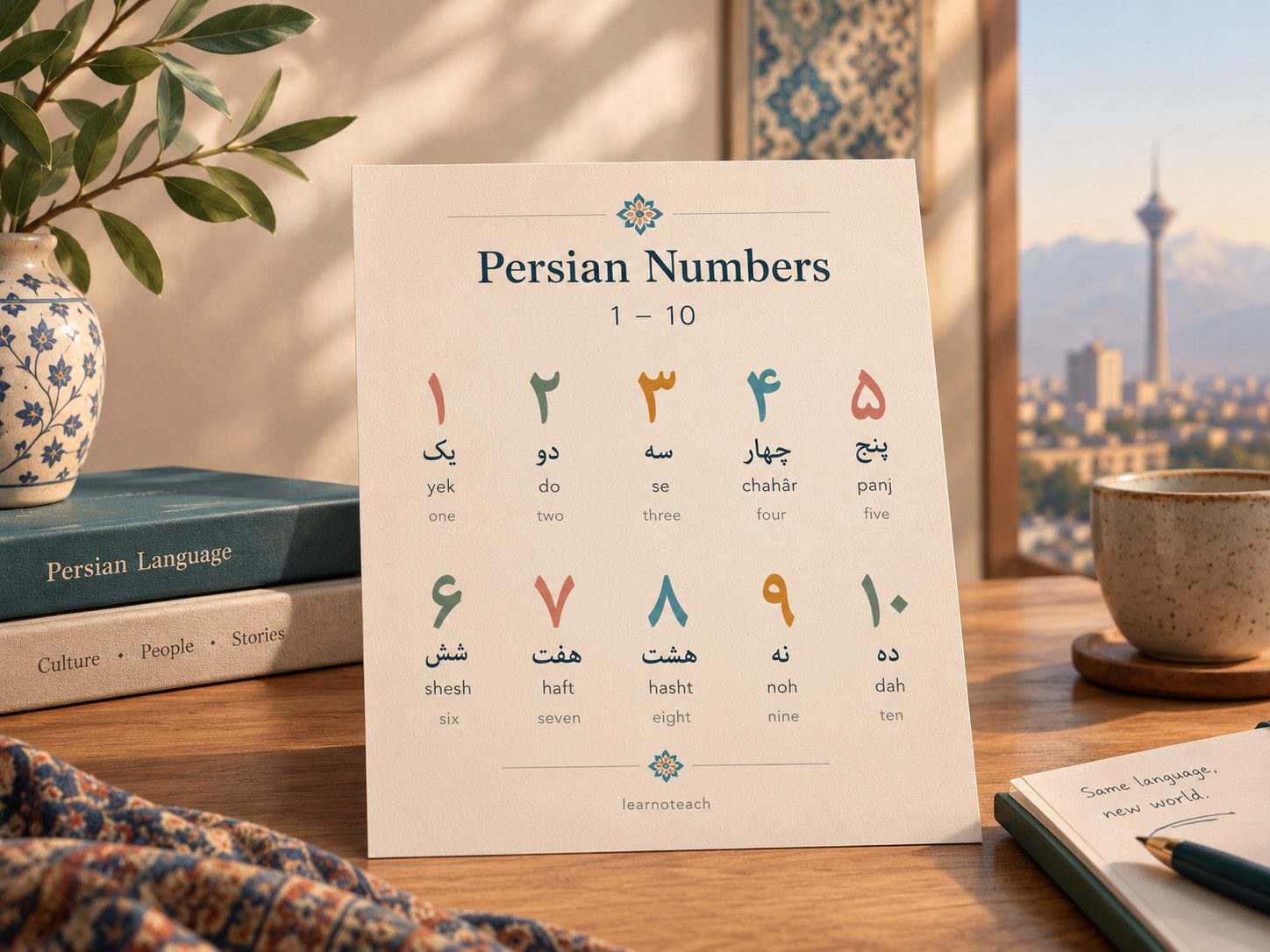
The best way to start learning Farsi numbers is to memorize the first ten. These numbers form the foundation for counting larger quantities, understanding prices, and building everyday expressions.
| Number | Persian Digit | Farsi | Pronunciation |
|---|---|---|---|
| 0 | ۰ | صفر | sefr |
| 1 | ۱ | یک | yek |
| 2 | ۲ | دو | do |
| 3 | ۳ | سه | se |
| 4 | ۴ | چهار | chahâr |
| 5 | ۵ | پنج | panj |
| 6 | ۶ | شش | shesh |
| 7 | ۷ | هفت | haft |
| 8 | ۸ | هشت | hasht |
| 9 | ۹ | نه | noh |
| 10 | ۱۰ | ده | dah |
Learning tip: Practice saying these numbers aloud in order, then try saying them backward. This simple exercise can help you recall them more quickly.
Pay special attention to se (three), panj (five), and hasht (eight). Some of their sounds may feel unfamiliar if English is your first language.
2. Persian Numbers 11–20
Once you know the first ten numbers, the next step is learning the numbers from eleven to twenty.
| Number | Persian Digit | Farsi | Pronunciation |
|---|---|---|---|
| 11 | ۱۱ | یازده | yâzdah |
| 12 | ۱۲ | دوازده | davâzdah |
| 13 | ۱۳ | سیزده | sizdah |
| 14 | ۱۴ | چهارده | chahârdah |
| 15 | ۱۵ | پانزده | pânzdah |
| 16 | ۱۶ | شانزده | shânzdah |
| 17 | ۱۷ | هفده | hefdah |
| 18 | ۱۸ | هجده | hejdah |
| 19 | ۱۹ | نوزده | nuzdah |
| 20 | ۲۰ | بیست | bist |
Notice that many numbers between eleven and nineteen share a similar ending. Recognizing this pattern can make them easier to remember, although their pronunciation is not always completely predictable.
For additional listening and pronunciation practice, Persian Online from the University of Texas at Austin offers a Persian numbers list with audio.
3. Persian Numbers 21–100
Here is the useful part: you do not have to memorize every number individually.
Persian numbers from 21 to 99 generally combine a tens word with a units word, joined by و, which is pronounced o in these expressions and means “and.”
For example:
- 21 = بیست و یک — bist-o yek
- 22 = بیست و دو — bist-o do
- 25 = بیست و پنج — bist-o panj
- 31 = سی و یک — si-o yek
- 46 = چهل و شش — chehel-o shesh
- 58 = پنجاه و هشت — panjâh-o hasht
- 73 = هفتاد و سه — haftâd-o se
- 99 = نود و نه — navad-o noh
Learn the Tens in Persian
Memorize these ten-based numbers first. You can then combine them with the numbers from one to nine.
| Number | Persian Digit | Farsi | Pronunciation |
|---|---|---|---|
| 20 | ۲۰ | بیست | bist |
| 30 | ۳۰ | سی | si |
| 40 | ۴۰ | چهل | chehel |
| 50 | ۵۰ | پنجاه | panjâh |
| 60 | ۶۰ | شصت | shast |
| 70 | ۷۰ | هفتاد | haftâd |
| 80 | ۸۰ | هشتاد | hashtâd |
| 90 | ۹۰ | نود | navad |
| 100 | ۱۰۰ | صد | sad |
For example, 24 is bist-o chahâr (twenty-four), while 67 is shast-o haft (sixty-seven).
Remember: The connector o is important. In standard Persian number expressions, it joins the tens and units together.
4. Persian Digits vs. English Digits
One thing that often surprises new learners is that Persian uses its own familiar set of digit shapes.
English commonly uses the digits 0, 1, 2, 3, and so on. In Iranian Persian, you will often encounter the following forms instead:
| English Digit | Persian Digit |
|---|---|
| 0 | ۰ |
| 1 | ۱ |
| 2 | ۲ |
| 3 | ۳ |
| 4 | ۴ |
| 5 | ۵ |
| 6 | ۶ |
| 7 | ۷ |
| 8 | ۸ |
| 9 | ۹ |
For example, the number 2026 can be written as ۲۰۲۶ in Persian digits.
Although Persian text is written from right to left, numbers are read from left to right, just as they are in English. This is an important detail when reading Persian dates, prices, phone numbers, and digital displays.
You may also see Western digits in Iranian websites, apps, and everyday digital communication.
5. How to Use Persian Numbers in Everyday Life
Memorizing numbers is useful, but learning to use them in real situations makes your knowledge much more valuable.
Asking About Prices
When shopping in Iran, you will frequently encounter prices expressed in tomans.
Question:
این چند است؟
In chand ast?
How much is this?
Answer:
پنجاه هزار تومان.
Panjâh hezâr tomân.
Fifty thousand tomans.
The word tomân (تومان) is commonly used when talking about money in everyday Iranian life.
Talking About Your Age
To say your age in Persian, you can use this simple structure:
من بیست سال دارم.
Man bist sâl dâram.
I am twenty years old.
You can replace bist with another number to talk about a different age.
Counting Objects
Persian speakers commonly use tâ (تا) as a counting word in everyday speech.
For example:
سه تا کتاب
Se tâ ketâb
Three books.
دو تا قهوه
Do tâ ghahve
Two coffees.
Using expressions like these helps you sound more natural when ordering food, shopping, or talking about everyday objects.
Asking for a Phone Number
Phone numbers are usually read digit by digit rather than as one large number.
For example, you can ask:
شماره تلفنت چنده؟
Shomâre telefonet chande?
What’s your phone number?
Understanding individual digits is therefore especially useful when exchanging contact information.
6. Persian Ordinal Numbers: First, Second, and Third
Cardinal numbers tell you how many things there are. Ordinal numbers tell you the position of something in a sequence.
| English | Persian | Pronunciation |
|---|---|---|
| First | اول | avval |
| Second | دوم | dovvom |
| Third | سوم | sevvom |
| Fourth | چهارم | chahârom |
| Fifth | پنجم | panjom |
| Sixth | ششم | sheshom |
| Seventh | هفتم | haftom |
| Eighth | هشتم | hashtom |
| Ninth | نهم | nohom |
| Tenth | دهم | dahom |
Many Persian ordinal numbers are formed by adding the ending -om to the corresponding cardinal number. However, some forms change slightly, and “first” is commonly expressed as avval.
For example:
طبقه دوم
Tabaghe-ye dovvom
The second floor.
روز سوم
Ruuz-e sevvom
The third day.
Learning these expressions will help you understand floor numbers, rankings, dates, and instructions.
7. Common Mistakes When Learning Farsi Numbers
A few simple mistakes can make Persian numbers more difficult than they need to be.
Confusing Persian digit shapes: Spend a little time recognizing ۴, ۵, and ۶. These are particularly useful to distinguish when reading prices and dates.
Forgetting the connector: In numbers such as 21 and 48, remember the o between the tens and units.
Reading numbers from right to left: Persian sentences run from right to left, but numbers themselves are read from left to right.
Learning without listening: Written transliteration is helpful, but listening to native speakers gives you a better sense of pronunciation and natural speech.
Memorizing without context: Practice numbers through prices, ages, phone numbers, and quantities instead of studying isolated lists alone.
For a broader learning plan, visit the Learnoteach blog for more articles about Persian vocabulary, pronunciation, and grammar.
8. Practice Persian Numbers: A Quick Quiz
Test yourself before moving on to more advanced vocabulary.
- How do you say 5 in Persian?
- What is the Persian word for 10?
- How do you say 21 in Farsi?
- What does panjâh mean?
- How would you write 100 using Persian digits?
Answers:
- پنج — panj
- ده — dah
- بیست و یک — bist-o yek
- Fifty (50)
- ۱۰۰
Try saying each answer aloud before checking the list. Recalling a word from memory is a useful way to strengthen your learning.
9. Continue Learning Persian
Numbers are just one part of learning Persian. Once you feel comfortable counting, you can start using your new vocabulary in sentences, conversations, and everyday situations.
The Persian Foundations beginner course is a good next step if you want to build a more structured foundation in Persian grammar, vocabulary, and conversation.
You can also browse the full collection of Learnoteach courses to find lessons that match your learning goals. If you enjoy learning through Iranian food and culture, explore the free recipe courses to discover Persian dishes while building cultural vocabulary.
For personalized guidance and speaking practice, you can book an online Persian class.
Conclusion: Start Counting in Farsi Today
Learning Persian numbers from 1 to 100 is a manageable goal for any beginner. Start with the first ten numbers, memorize the tens, and use the simple o connector to build larger numbers.
With regular practice, you will be able to recognize Persian digits, understand common prices, talk about your age, and count everyday objects with greater confidence.
The key is to use numbers in real situations rather than simply memorizing a list. Practice a little each day, listen to native Persian speakers, and gradually introduce new expressions into your conversations.
For more bite-sized Persian learning content, follow Learnoteach on Instagram and TikTok.
Frequently Asked Questions
How do you count from 1 to 10 in Persian?
The numbers are yek, do, se, chahâr, panj, shesh, haft, hasht, noh, and dah. In Persian script, they are یک، دو، سه، چهار، پنج، شش، هفت، هشت، نه، and ده.
How do you say 100 in Farsi?
One hundred is sad (صد), and it is written as ۱۰۰ using Persian digits.
Are Persian numbers written from right to left?
Persian text is written from right to left, but numbers are read from left to right, just as in English.
What is the difference between Farsi numbers and Persian numbers?
There is no meaningful difference in everyday language-learning contexts. “Farsi numbers” and “Persian numbers” refer to the same number system used in the Persian language.
How can I learn Persian numbers faster?
Practice the numbers from one to ten first, memorize the tens, and learn how to combine them. Listening to native speakers and using numbers in practical examples can make them easier to remember.
How do you say 21 in Persian?
Twenty-one is bist-o yek (بیست و یک). The word o means “and” and connects the tens with the units.
Why should I learn Persian numbers?
Persian numbers are useful for shopping, understanding prices, telling time, discussing age, reading dates, exchanging phone numbers, and communicating during a visit to Iran.