If you are interested in learning languages, you may have wondered: Is Farsi the same as Arabic? Because both languages are widely spoken in the Middle East and use a similar writing system, they are sometimes confused with each other. However, Farsi and Arabic are two distinct languages with different origins, grammar, pronunciation, vocabulary, and cultural backgrounds.
Understanding the differences between Farsi vs. Arabic can help you choose the right language to learn and avoid some common misconceptions.
Is Farsi the Same as Arabic?
No. Farsi and Arabic are completely different languages.
Farsi, also known as Persian, belongs to the Indo-European language family, while Arabic belongs to the Semitic language family. They developed independently and have different grammatical structures and linguistic histories.
Farsi is primarily spoken in Iran, Afghanistan, and Tajikistan, where it is known by names such as Persian, Dari, and Tajik. Arabic, on the other hand, is spoken across a large part of the Middle East and North Africa.
The confusion often comes from the fact that modern Persian uses a writing system based on the Arabic script and contains many Arabic loanwords. Nevertheless, knowing Arabic does not automatically mean that you can speak or understand Farsi.
Farsi vs. Arabic: Language Family
One of the most important differences between the two languages is their linguistic origin.
Farsi: An Indo-European Language
Farsi belongs to the Indo-European family, the same broad language family that includes English, German, French, Spanish, Russian, Hindi, and many other languages.
Persian has a long history dating back thousands of years. Modern Farsi developed from earlier stages of the Persian language, including Old Persian and Middle Persian.
Arabic: A Semitic Language
Arabic belongs to the Semitic branch of the Afro-Asiatic language family. It is closely related to languages such as Hebrew and Aramaic.
Arabic has its own grammatical system based heavily on roots and patterns, which is quite different from the structure of Farsi.
This fundamental difference means that Farsi is not a dialect of Arabic, despite the similarities in their writing systems and vocabulary.
The Farsi and Arabic Alphabets
Another common source of confusion is the alphabet.
Modern Farsi uses a modified version of the Arabic script. As a result, many letters look identical or similar in both languages.
However, the Persian alphabet has four additional letters that are not part of the standard Arabic alphabet:
- پ — pe
- چ — che
- ژ — zhe
- گ — gaf
These letters represent sounds that are common in Persian but do not exist in Classical or Standard Arabic.
There are also differences in how certain letters are pronounced.
For example, the Persian word چای (chāy) means “tea.” The letter چ represents the “ch” sound, as in the English word “chair.”
Arabic does not traditionally have this sound represented by a corresponding letter.
Do Farsi and Arabic Sound the Same?
No. The pronunciation systems are significantly different.
Farsi generally has a relatively straightforward pronunciation system for English speakers. Modern Persian does not use the same system of grammatical case endings and emphatic consonants found in Arabic.
Arabic contains several sounds that can be challenging for Persian learners, including sounds produced deep in the throat and distinctions between consonants that do not exist in Persian.
For example, Arabic differentiates between several consonants that may sound similar to learners from other linguistic backgrounds.
Farsi pronunciation is generally more consistent, although Persian learners still need to practice sounds such as خ (kh) and ق/غ (gh/q).
Farsi vs. Arabic Grammar
Grammar is another major difference between Farsi and Arabic.
Persian Grammar
Persian grammar has several features that can make it relatively approachable for English speakers.
For example, Persian generally follows a Subject-Object-Verb (SOV) word order:
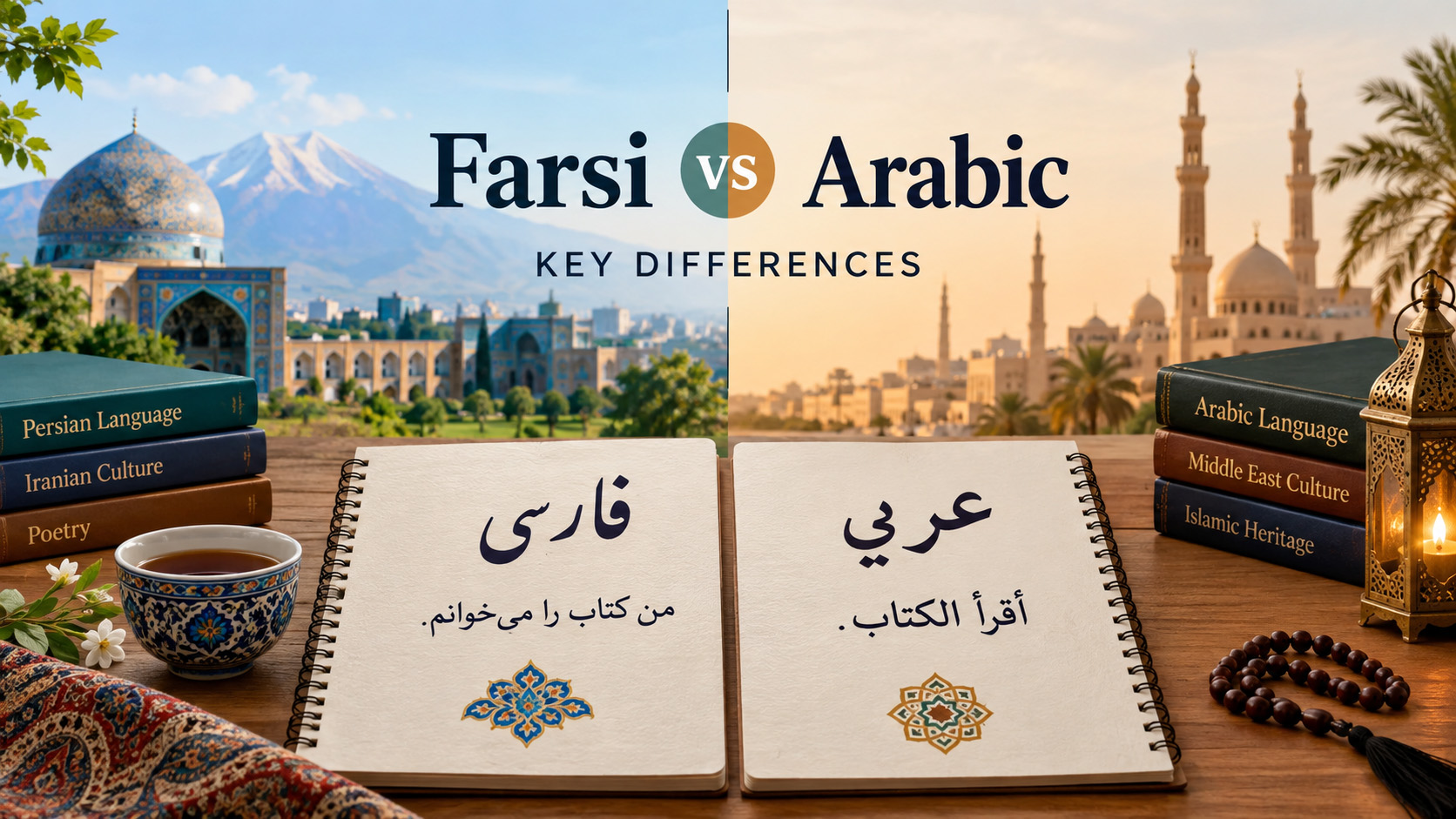
من کتاب را میخوانم.
Man ketāb rā mikhānam.
“I read the book.”
Literally, the structure is closer to:
I book object-marker read.
Persian also does not have grammatical gender for nouns. In other words, nouns are not classified as masculine or feminine in the same way they are in Arabic.
Arabic Grammar
Arabic has a much more complex grammatical system in several areas. Nouns can have grammatical gender, and Standard Arabic has grammatical case endings.
Arabic verbs are also strongly connected to consonantal roots and patterns. A large number of Arabic words are formed from three-consonant roots.
This makes Arabic vocabulary formation fundamentally different from Persian.
Farsi and Arabic Vocabulary
Farsi and Arabic share a substantial amount of vocabulary because of centuries of historical and cultural contact.
Persian contains thousands of words borrowed from Arabic, particularly in areas such as:
- Religion
- Philosophy
- Literature
- Government
- Science
- Education
- Law
For example:
- کتاب (ketāb) — book
- مدرسه (madrese) — school
- تاریخ (tārikh) — history
- انسان (ensān) — human
- دنیا (donyā) — world
Many of these words originated in Arabic but have become fully integrated into Persian.
However, this does not mean that Persian and Arabic vocabulary is interchangeable. Persian has its own extensive native vocabulary and has also borrowed words from other languages, including French, English, and Russian.
Why Does Farsi Use the Arabic Script?
Persian historically used different writing systems. After the Islamic conquest of Persia, the Arabic script gradually became the dominant writing system for Persian.
Persian speakers adapted the Arabic script to represent Persian sounds that Arabic did not have. This resulted in the addition of letters such as پ, چ, ژ, and گ.
Today, Persian is written from right to left, just like Arabic.
This visual similarity can make the two languages appear much more closely related than they actually are.
Can Arabic Speakers Understand Farsi?
Usually, not automatically.
An Arabic speaker may recognize some Persian words because of shared Arabic vocabulary. However, understanding an entire Persian sentence requires knowledge of Persian grammar, vocabulary, and pronunciation.
The same is true in the opposite direction. A Persian speaker who has never studied Arabic may recognize familiar Arabic-origin words but will generally not understand spoken Arabic.
This is similar to how speakers of two different languages may recognize some shared international or borrowed words without being able to communicate fluently.
Farsi vs. Arabic: A Quick Comparison
| Feature | Farsi (Persian) | Arabic |
|---|---|---|
| Language family | Indo-European | Semitic |
| Main region | Iran and parts of Afghanistan and Central Asia | Middle East and North Africa |
| Writing direction | Right to left | Right to left |
| Script | Persian-Arabic script | Arabic script |
| Extra Persian letters | پ، چ، ژ، گ | Not used in standard Arabic |
| Grammatical gender | No grammatical gender | Masculine and feminine |
| Basic word order | Generally SOV | Generally VSO/SVO depending on variety and context |
| Vocabulary | Persian + many loanwords | Primarily Semitic roots + extensive borrowings |
| Relationship | Independent language | Independent language |
Which Is Easier to Learn: Farsi or Arabic?
The answer depends on your native language and your learning goals.
For many English speakers, Farsi can be easier to learn than Arabic because Persian has relatively simple noun gender, a comparatively regular grammatical system, and no complex system of grammatical case endings in everyday modern usage.
Arabic can be more challenging because learners may need to deal with both Modern Standard Arabic and regional dialects. The difference between written Standard Arabic and spoken varieties can also add complexity.
That said, Arabic and Farsi both have their own challenges, and the best choice depends on why you want to learn the language.
If you are interested in Iranian culture, traveling to Iran, Persian literature, or communicating with Persian speakers, learning Farsi is the natural choice.
Should You Learn Farsi or Arabic?
Consider your goals.
Choose Farsi if you want to:
- Travel to Iran
- Communicate with Persian speakers
- Explore Persian culture and history
- Read Persian literature and poetry
- Learn about Iranian society
- Watch Persian movies and television
- Build connections with Persian-speaking communities
Choose Arabic if you want to:
- Communicate across Arabic-speaking countries
- Study Arabic literature
- Understand Arabic media
- Study Islamic texts in Arabic
- Work or travel extensively in Arab countries
- Explore the cultures of the Middle East and North Africa
If your primary goal is learning about Iran and Persian culture, Farsi is the language to focus on.
Why Learn Farsi?
Learning Farsi opens the door to one of the world’s oldest literary and cultural traditions.
Persian literature includes internationally celebrated poets such as Rumi, Hafez, Saadi, and Ferdowsi. Learning Persian also allows you to experience their works in the original language rather than relying entirely on translations.
Farsi can also be useful for travelers, researchers, students, diplomats, journalists, and anyone interested in Iran and the broader Persian-speaking world.
For beginners, learning everyday Persian phrases and building a strong foundation in pronunciation and basic grammar can be an excellent starting point.
Learn Farsi Online with Learnoteach
If you are comparing Farsi vs. Arabic because you want to learn Persian, you do not need to master the entire language at once.
At Learnoteach, you can start learning Persian step by step with practical lessons designed for learners of different levels.
Whether your goal is traveling to Iran, communicating with Persian speakers, understanding Iranian culture, or simply exploring a new language, learning Farsi can be a rewarding experience.
Explore the Persian learning resources and courses available on Learnoteach and start building your Persian skills one lesson at a time.
Final Thoughts: Farsi vs. Arabic
Although Farsi and Arabic share the same general writing direction and have influenced each other throughout history, they are fundamentally different languages.
Farsi is an Indo-European language with Persian roots, while Arabic is a Semitic language. They differ in grammar, pronunciation, vocabulary, and linguistic structure.
The biggest similarity is historical and cultural interaction—not a shared linguistic origin.
So, if you see Persian written in a script that looks Arabic, remember: Farsi is not Arabic, and Persian speakers are not simply speaking an Arabic dialect.
Understanding this distinction is an important first step for anyone interested in learning Persian and discovering the rich culture of Iran.