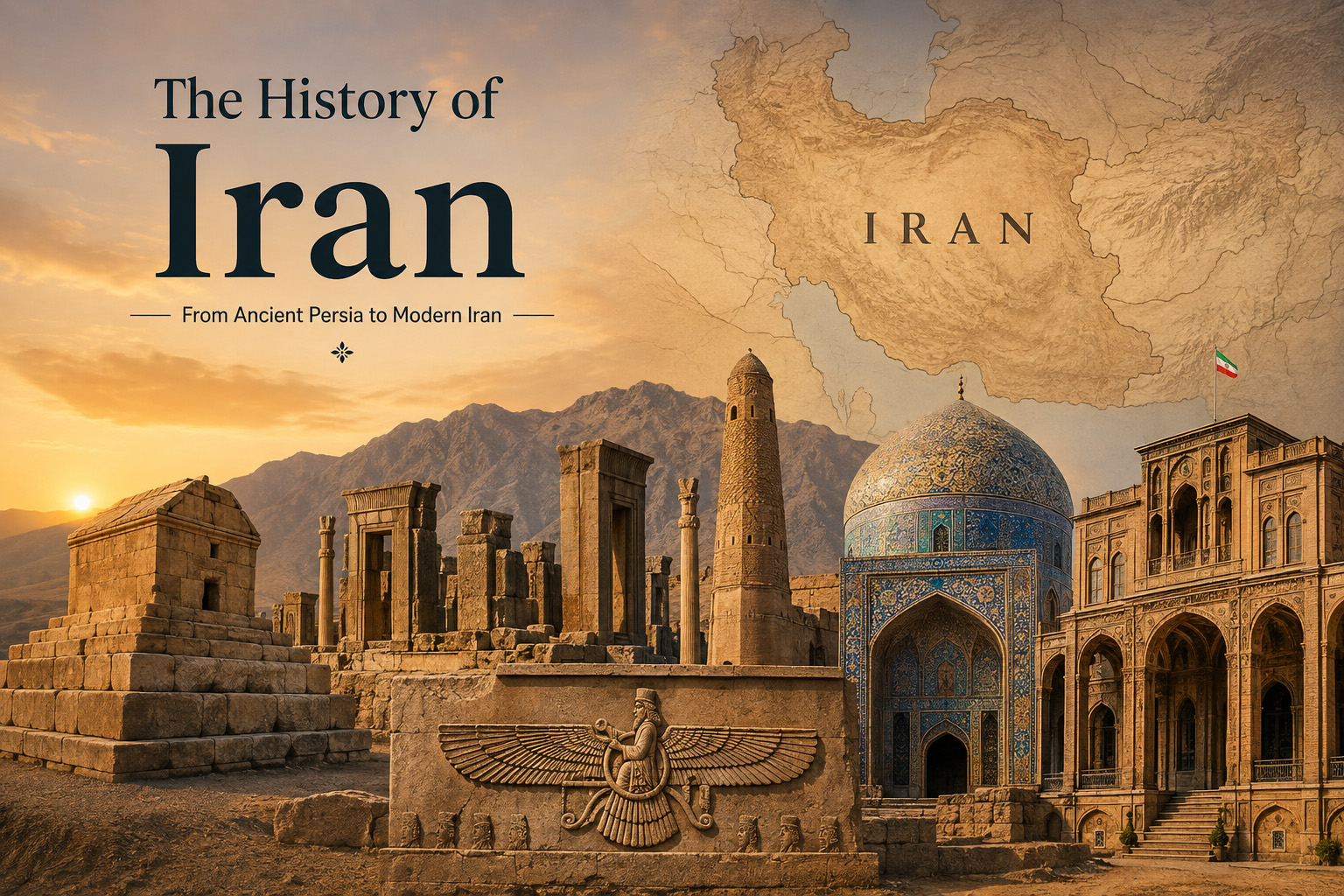
Iran has one of the world’s longest and most fascinating histories. Long before the country was known internationally as Iran, the region was home to powerful kingdoms, sophisticated cities, influential religions, and some of the largest empires of the ancient world.
The history of Iran stretches from the civilizations of ancient Persia to the Persian Empire, the arrival of Islam, the rise of the Safavid dynasty, the Qajar and Pahlavi periods, and the establishment of the Islamic Republic in 1979.
Understanding the history of Iran is also an important way to understand Persian culture, language, traditions, literature, architecture, and the identity of modern Iranian society.
In this brief guide, we will explore the major periods of Iranian history and discover how ancient Persia gradually became modern Iran.
Iran or Persia? Understanding the Names
Before looking at the timeline, it is useful to understand the difference between Iran and Persia.
The name “Persia” comes from Persis, the Greek name associated with the region of Parsa in southwestern Iran. This area became the heartland of the Achaemenid Persian Empire.
“Iran,” however, comes from an older Iranian linguistic tradition and is related to the Middle Persian Ērān. The modern official name Islamic Republic of Iran reflects the country’s long historical and linguistic development.
Therefore, Persian history and Iranian history overlap, but they are not exactly the same thing. Iran’s history includes many peoples, languages, kingdoms, and cultures beyond the Persian heartland.
A Timeline of Iranian History
Here is a simplified Iran history timeline:
| Period | Approximate Dates | Major Developments |
|---|---|---|
| Ancient civilizations | Before 550 BCE | Elam, Medes and other early civilizations |
| Achaemenid Empire | c. 550–330 BCE | Cyrus the Great, Darius, Xerxes |
| Hellenistic period | 330–247 BCE | Alexander and the Seleucids |
| Parthian Empire | c. 247 BCE–224 CE | Arsacid rule and Rome’s eastern rival |
| Sasanian Empire | 224–651 CE | Last major pre-Islamic Persian empire |
| Early Islamic period | 7th–10th centuries | Islamization and new Persian dynasties |
| Mongol & Timurid periods | 13th–15th centuries | Mongol invasion and cultural transformation |
| Safavid Empire | 1501–1722 | Political reunification and Shi’a Islam |
| Afsharid & Zand periods | 18th century | Nader Shah and later Zand rule |
| Qajar Dynasty | 1789–1925 | Constitutional Revolution and foreign influence |
| Pahlavi Dynasty | 1925–1979 | Modernization and centralization |
| Islamic Republic | 1979–present | A new political system and modern Iran |
1. Ancient Iran Before the Persian Empire
The story of Iran begins thousands of years before the rise of the famous Persian Empire.
One of the most important early civilizations was Elam, which developed in southwestern Iran, particularly around the region of present-day Khuzestan. Elam had its own political institutions, writing traditions, religious practices, and cities.
Other groups, including the Medes, also played important roles in the development of Iranian civilization.
These early societies created cultural and political foundations that later rulers would inherit and transform.
The geographical position of Iran was particularly important. Located between Mesopotamia, Central Asia, the Caucasus, South Asia, and the Persian Gulf, the Iranian plateau became a crossroads for trade, migration, warfare, and cultural exchange.
2. The Achaemenid Empire: The Rise of Ancient Persia
When people think about ancient Persia, they often think of the Achaemenid Empire.
The Achaemenid dynasty rose to power in the 6th century BCE under Cyrus the Great. His conquests created one of the largest empires the ancient world had seen.
Cyrus and his successors controlled enormous territories extending across parts of the Middle East, Central Asia, Egypt, and Anatolia.
One of the most important features of the Achaemenid Empire was its ability to govern a highly diverse population.
Rather than creating a completely uniform culture across the empire, Persian rulers incorporated different peoples, traditions, and administrative practices into a large imperial system.
UNESCO describes Pasargadae as an exceptional witness to Achaemenid civilization and notes the empire’s extraordinary geographical extent and cultural diversity.
Cyrus the Great
Cyrus II, better known as Cyrus the Great, established the Achaemenid Empire around the middle of the 6th century BCE.
He founded Pasargadae, which became one of the major royal centers of the early Persian Empire.
His legacy has remained an important part of discussions about ancient Persian political history.
Persepolis: The Symbol of the Persian Empire
One of the most famous archaeological sites in Iran is Persepolis.
Construction began under Darius I around 518 BCE. The monumental complex included enormous halls, stairways, reliefs, and royal buildings.
UNESCO considers Persepolis one of the world’s major archaeological sites and describes it as an outstanding expression of Achaemenid architecture, art, and royal culture.


The reliefs at Persepolis depict delegations from different parts of the empire bringing gifts to the Persian king. These images provide an extraordinary visual record of the multicultural character of the Achaemenid Empire.
For anyone interested in Persian culture, Persepolis is more than an archaeological site. It represents the artistic, political, and cultural achievements of one of the most influential civilizations of the ancient world.
3. Alexander the Great and the Hellenistic Period
The Achaemenid Empire eventually faced the armies of Alexander the Great.
In 330 BCE, Alexander conquered Persepolis and the Achaemenid Empire came to an end.
The following period brought significant Greek and Hellenistic influence to the Iranian plateau.
Greek political and cultural traditions interacted with existing Iranian traditions, creating a complex cultural environment that would continue to influence the region for centuries.
However, Persian political traditions did not disappear.
Instead, they continued to evolve under later Iranian dynasties.
4. The Parthian Empire
The Parthian Empire, also known as the Arsacid Empire, emerged in the 3rd century BCE.
The Parthians controlled a vast territory and became one of Rome’s most important rivals in the East.
Their empire played a major role in connecting the Mediterranean world with Central Asia and the Silk Road.
The Parthians were particularly famous for their cavalry and military tactics.
They also contributed to the development of Iranian political and cultural traditions that would later influence the Sasanians.
5. The Sasanian Empire: The Last Great Pre-Islamic Persian Empire
In 224 CE, the Sasanian Empire replaced the Parthians.
The Sasanians created a highly centralized state and developed a sophisticated administrative and cultural system.
Their empire competed directly with the Roman and later Byzantine Empires.
Religion was also particularly important during this period. Zoroastrianism played a central role in Sasanian political and religious life.
The Sasanian period is extremely important for understanding later Iranian culture because many traditions in administration, art, architecture, literature, and political thought continued beyond the end of the empire.
6. The Arab Conquest and the Arrival of Islam
The 7th century brought one of the most important transformations in the history of Iran.
Arab Muslim armies defeated the Sasanian Empire, and by the middle of the 7th century much of the Iranian plateau had come under Muslim rule.
However, the transformation was not instantaneous.
According to Encyclopaedia Iranica, Arab control spread across Iranian territories during the 7th century, while the conversion of the population to Islam occurred gradually over a much longer period.
This distinction is important.
The arrival of Islam did not simply erase the culture of pre-Islamic Persia. Instead, Iranian and Islamic traditions gradually interacted and produced a new Persian-Islamic civilization.
7. The Persian Language and the Islamic Golden Age
One of the most fascinating aspects of Iranian history is the survival and development of the Persian language after the Arab conquest.
Over the following centuries, Persian became a major literary and cultural language across a large part of the Islamic world.
Persian literature produced some of the world’s most influential poets and writers, including:
- Ferdowsi
- Rumi
- Hafez
- Saadi
- Omar Khayyam
- Attar
The Shahnameh, written by Ferdowsi around the turn of the 11th century, played an enormous role in preserving Iranian historical and mythological traditions.
This is one reason that learning Persian can be much more than learning a language. It can provide direct access to centuries of Iranian literature, history, poetry, and culture.
👉 Learn Persian with Learnoteach
8. Mongol Invasion and the Timurid Period
In the 13th century, Iran experienced another major transformation with the arrival of the Mongols.
The Mongol invasions caused enormous destruction in many regions, but Iranian civilization eventually adapted to Mongol political rule.
Later, the Ilkhanids became important patrons of Persian culture and administration.
The Timurid period that followed also became an important era of artistic and intellectual development.
Cities such as Herat became major centers of literature, architecture, painting, and scholarship.
The history of Iran during this period demonstrates an important recurring pattern: foreign conquest could dramatically change Iranian political structures without eliminating Persian cultural traditions.
9. The Safavid Empire: A Turning Point in Iranian History
The rise of the Safavid dynasty in 1501 was one of the most important turning points in Iranian history.
The Safavids established political control over much of Iran and played a crucial role in creating a more unified Iranian state.
They also established Twelver Shi’a Islam as the state religion, a decision that had a profound and lasting influence on Iranian identity and politics.
Encyclopaedia Iranica describes the Safavid period as an important stage in the development of modern Persian history and emphasizes its role in unifying much of Persia under a single political authority.
Shah Abbas I
One of the most famous Safavid rulers was Shah Abbas I.
During his reign, the Safavid state reached a high point in political power, economic activity, architecture, and international relations.
Isfahan became the spectacular center of Safavid Iran.


The architecture of Isfahan remains one of the most visible legacies of the Safavid era.
10. Nader Shah and the Zand Dynasty
After the decline of the Safavid state, Iran experienced political instability.
Nader Shah emerged as one of the most powerful military leaders of the 18th century. His campaigns expanded Iranian power far beyond the country’s traditional borders.
After his death, political fragmentation returned.
The Zand dynasty, associated particularly with Karim Khan Zand, ruled parts of Iran during the later 18th century.
Although the Zand period was relatively short, it is remembered for a comparatively peaceful period in some parts of the country and for the development of Shiraz as an important cultural center.
11. The Qajar Dynasty and the Constitutional Revolution
The Qajar dynasty came to power toward the end of the 18th century and ruled Iran until 1925.
The Qajar era was marked by major challenges.
Iran faced increasing pressure from powerful neighboring states, especially Russia and Britain. The country also experienced internal political struggles and attempts at modernization.
One of the most important events of this period was the Persian Constitutional Revolution of 1905–1911.
The Constitutional Revolution sought to establish limits on royal authority and create a parliament.
It represented a major development in Iran’s transition toward modern political institutions.
12. The Pahlavi Era and Modernization
In 1925, Reza Shah Pahlavi established the Pahlavi dynasty.
The Pahlavi period was characterized by rapid modernization and centralization.
The government expanded infrastructure, education, transportation, and state institutions while attempting to create a more centralized modern state.
Reza Shah also promoted changes in dress, education, administration, and public life.
His son, Mohammad Reza Shah Pahlavi, succeeded him in 1941.
During the following decades, Iran experienced significant economic and social transformation, particularly after the growth of the oil industry.
At the same time, political opposition and debates over modernization, political participation, foreign influence, and the role of religion became increasingly important.
13. The Iranian Revolution of 1979
The political system of Iran changed dramatically in 1979.
A broad revolutionary movement led to the fall of the Pahlavi monarchy.
Following the revolution, the Islamic Republic of Iran was established.
The revolution represented one of the most significant political transformations in modern Middle Eastern history.
Iran subsequently developed a political system combining elected institutions with religious leadership.
14. Iran in the Modern Era
Modern Iran is a country shaped by thousands of years of historical continuity and change.
Its contemporary identity reflects many layers of history:
- Ancient Iranian civilizations
- Achaemenid and Sasanian traditions
- Islamic culture
- Persian literature
- Shi’a religious traditions
- Safavid political heritage
- Qajar constitutionalism
- Pahlavi modernization
- The 1979 Revolution
- Contemporary global influences
This combination makes Iran particularly interesting for students of history, culture, languages, and international affairs.
Why Is Iranian History Important for Persian Language Learners?
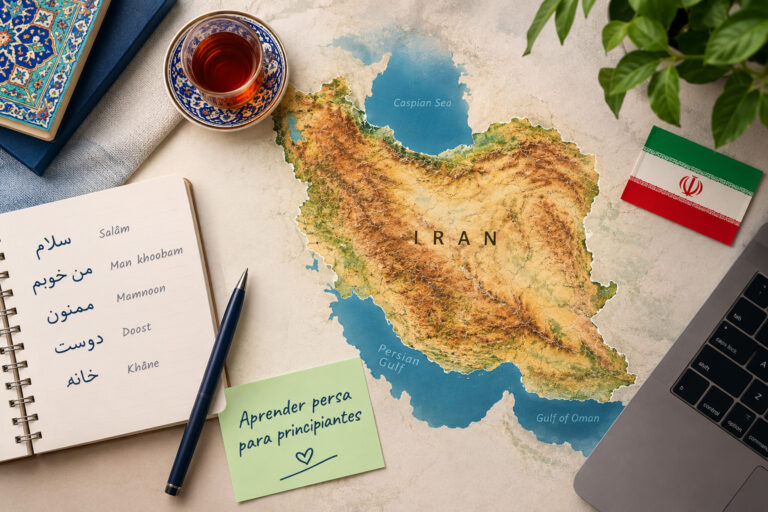
Learning the Persian language can provide a different way of understanding Iranian history.
Many Persian words, expressions, names, poems, and cultural references are connected to historical events and traditions.
For example, understanding figures such as Cyrus the Great, Ferdowsi, Rumi, Hafez, and Shah Abbas can make Persian literature and everyday cultural references much easier to understand.
Likewise, learning about Nowruz, Persian mythology, Iranian food, poetry, and traditional celebrations can make language learning more meaningful.
At Learnoteach, language learning can be combined with cultural exploration so that students don’t simply learn Persian vocabulary—they gain a better understanding of the people and culture behind the language.
Iranian Culture: More Than Ancient Persia
When people first encounter Iran, they may associate the country primarily with ancient sites such as Persepolis.
But Iranian culture is much broader than ancient Persia.
Iranian civilization has continuously changed through interaction among different peoples, religions, languages, dynasties, and neighboring civilizations.
Its cultural heritage includes:
Persian Poetry
Persian poetry is one of Iran’s most influential cultural traditions. The works of Rumi, Hafez, Saadi, Ferdowsi, and other poets remain widely read today.
Persian Food
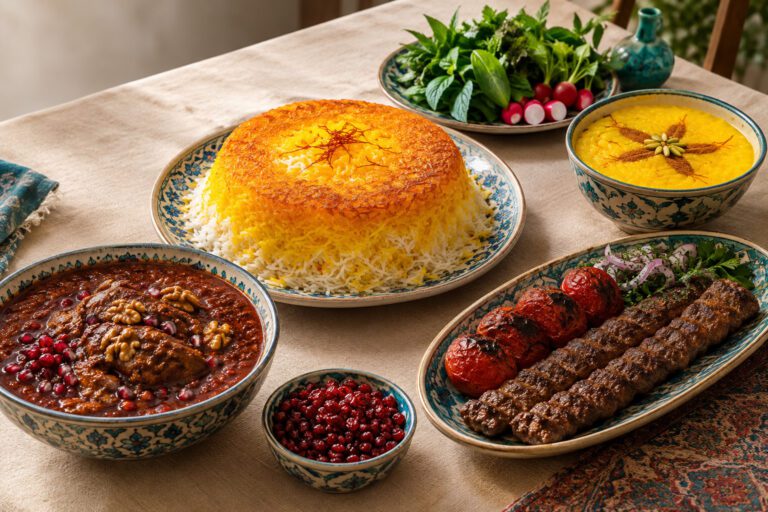
Iranian cuisine includes dishes such as:
- Ghormeh Sabzi
- Fesenjan
- Zereshk Polo
- Tahdig
- Ash Reshteh
- Sholeh Zard
If you’re interested in experiencing Iranian culture through food, Learnoteach can also introduce learners to Persian recipes and cultural traditions.
Related Learnoteach content:
👉 [Sholeh Zard recipe]
Nowruz
Nowruz, the Persian New Year, is one of the most important cultural traditions associated with Iran and several other countries in the region.
Its roots extend deep into Iranian history and pre-Islamic traditions, while the celebration continues in contemporary Iranian society.
Persian Architecture
From Persepolis and Pasargadae to Safavid Isfahan, Iranian architecture demonstrates the extraordinary diversity of Persian artistic traditions.
A Brief History of Iran in 10 Key Dates
If you only have a few minutes, remember these important dates:
c. 550 BCE — Rise of the Achaemenid Empire
Cyrus the Great establishes the foundations of the Persian Empire.
518 BCE — Construction of Persepolis begins
Darius I begins the construction of the monumental royal complex.
330 BCE — Fall of the Achaemenid Empire
Alexander the Great conquers the Persian Empire.
224 CE — Rise of the Sasanian Empire
The Sasanians replace the Parthians.
651 CE — End of the Sasanian Empire
The Arab-Muslim conquest brings the Sasanian state to an end.
1501 — Rise of the Safavids
The Safavids establish a powerful Iranian state and make Twelver Shi’a Islam the state religion.
1905–1911 — Constitutional Revolution
Iran experiences a major political movement for constitutional government.
1925 — Beginning of the Pahlavi Dynasty
Reza Shah establishes a centralized modernizing state.
1979 — Iranian Revolution
The monarchy is overthrown and the Islamic Republic is established.
Today — Modern Iran
Iran continues to combine ancient heritage, Persian culture, Islamic traditions, and modern global influences.
Final Thoughts: From Persia to Iran
The history of Iran is not a simple story of one empire replacing another.
It is a story of continuity.
The Achaemenid Empire disappeared, but Persian political and cultural traditions survived.
The Sasanian Empire ended, but Iranian culture continued to evolve within the Islamic world.
The Mongols conquered Iran, yet Persian literature and administration flourished again.
The Safavids transformed Iran’s political and religious identity, while later Qajar and Pahlavi rulers shaped the foundations of the modern state.
And today, modern Iran remains deeply connected to this extraordinary past.
From Persepolis to Isfahan, from Ferdowsi to Hafez, and from ancient Persia to modern Tehran, the story of Iran is ultimately a story of cultural survival, transformation, and continuity.
For language learners, exploring this history offers an excellent way to understand why Persian is much more than a means of communication—it is a gateway to one of the world’s richest cultural traditions.
Ready to explore Persian language and culture?
👉 [Explore Learnoteach Persian Courses]
👉 [Start Persian Foundations]
👉 [Explore Learnoteach Blog]
FAQ
What is the history of Iran?
The history of Iran spans thousands of years, from ancient civilizations such as Elam and the Medes through the Achaemenid, Parthian, and Sasanian empires, the Islamic period, the Safavid, Qajar, and Pahlavi dynasties, and the establishment of the Islamic Republic in 1979.
Was Iran called Persia?
Yes. Persia was a historical name widely used in Western languages for Iran. The name was derived from Persis, the region associated with the Persian heartland. “Iran” is the country’s historical name in Iranian languages and is the official name used today.
Who founded the Persian Empire?
Cyrus the Great is generally regarded as the founder of the Achaemenid Persian Empire in the 6th century BCE.
What is Persepolis?
Persepolis was a major royal center of the Achaemenid Empire. Construction began under Darius I around 518 BCE, and its monumental ruins are among Iran’s most important archaeological sites.
What dynasty made Shi’a Islam the state religion of Iran?
The Safavid dynasty established Twelver Shi’a Islam as the state religion when it came to power in 1501.
When did modern Iran begin?
There is no single date for the beginning of modern Iran. The Safavid period is often considered a major starting point for modern Iranian political history, while the Qajar Constitutional Revolution, Pahlavi modernization, and the 1979 Revolution were also crucial stages in the development of contemporary Iran.
Why should Persian learners study Iranian history?
Iranian history helps language learners understand Persian literature, cultural references, traditions, festivals, historical figures, and everyday expressions. Learning Persian alongside Iranian culture can make the language more meaningful and easier to contextualize.