If you are thinking about learning Persian, one of the first questions you may have is: How long does it take to learn Persian?
The honest answer is that there is no single number that applies to everyone.
Some learners can introduce themselves and have simple conversations after a few months of consistent study. Others may need much longer to become comfortable with everyday conversations, reading, and natural spoken Persian.
The time it takes depends on your goals, study routine, previous language-learning experience, exposure to Persian, and how much time you spend actually using the language.
The good news is that you do not need to become fluent before you can start using Persian.
You can begin communicating with basic words and sentences relatively early in your learning journey.
In this guide, we will look at how long it may take to learn Persian at different levels, how many hours you should study, what affects your progress, and how to make your Persian learning journey more efficient.
So, How Long Does It Take to Learn Persian?
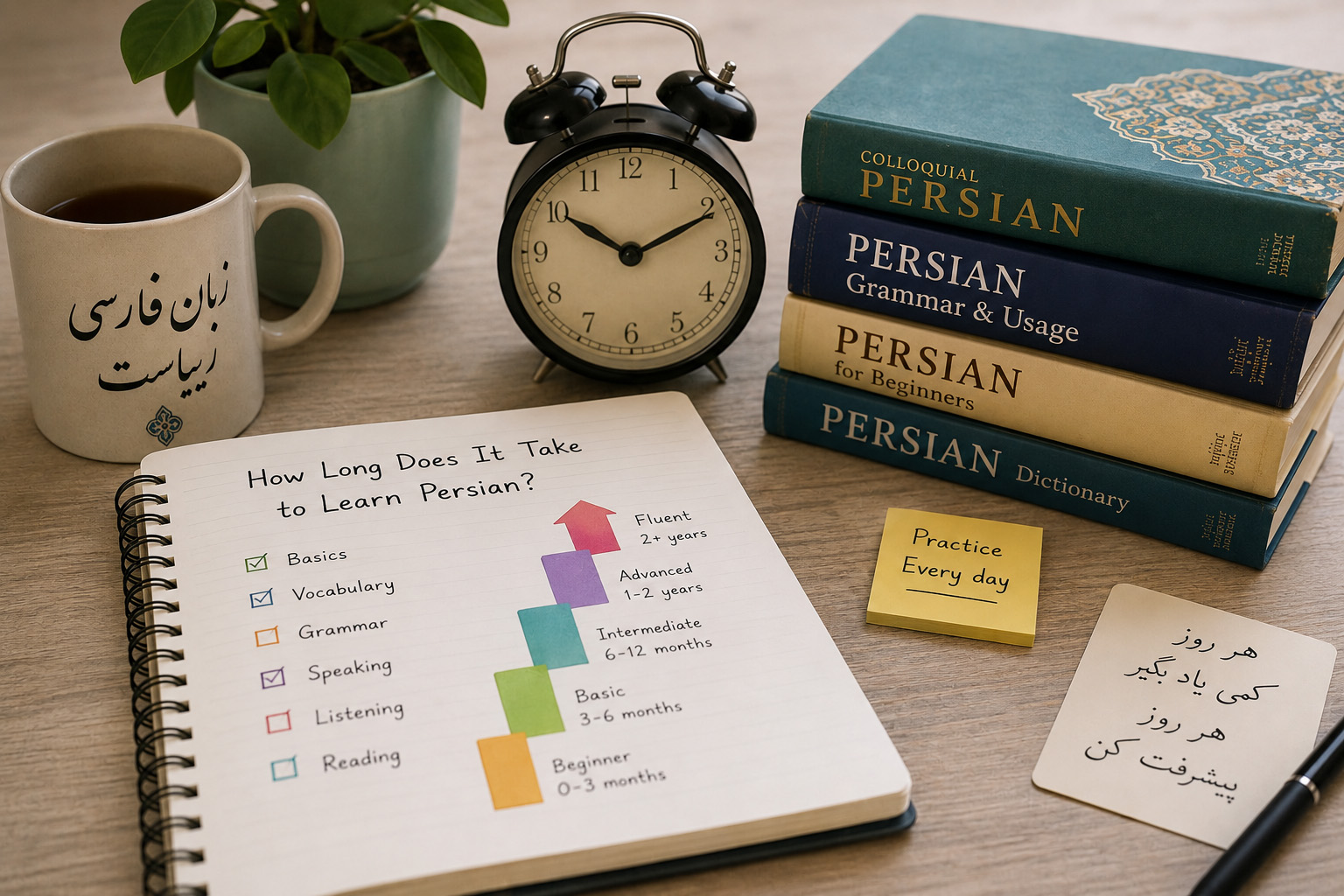
For a motivated beginner studying consistently, a realistic progression might look something like this:
- 1–3 months: Basic words, phrases, pronunciation, and introductions
- 3–6 months: Simple everyday conversations and basic comprehension
- 6–12 months: Stronger conversational ability and more comfortable reading
- 1–2 years: Intermediate communication with regular practice
- 2+ years: Advanced communication, depending on exposure and intensity
These are general estimates, not guarantees.
Someone who studies Persian for 30 minutes every day may progress very differently from someone who studies for two or three hours a day and regularly speaks with native Persian speakers.
Your goal also matters.
Learning enough Persian for a trip to Iran is very different from learning Persian well enough to read literature or work professionally in a Persian-speaking environment.
The Most Important Question: What Does “Learn Persian” Mean?
Before estimating how long Persian will take, you need to define what “learn” means to you.
There are several different goals you might have.
Maybe you want to:
- Understand basic Persian phrases
- Travel to Iran
- Talk to Persian-speaking friends
- Speak with your partner’s family
- Watch Persian movies
- Read Persian websites
- Read Persian literature
- Study or work in a Persian-speaking environment
- Become conversational
- Become fluent
Each goal requires a different level of ability.
For example, learning enough Persian to order food and ask for directions could take a relatively short period of focused study.
Becoming highly proficient in Persian requires much more vocabulary, listening practice, grammar knowledge, reading, and real-world communication.
So instead of asking only “How long does it take to learn Persian?”, ask:
“How much Persian do I need for my goal?”
That question gives you a much more useful answer.
How Long Does It Take to Learn Basic Persian?
If your goal is simply to communicate in basic situations, you can make noticeable progress within your first few months.
A beginner can start by learning:
- Greetings
- Numbers
- Days and time
- Common questions
- Basic verbs
- Food and drinks
- Family vocabulary
- Directions
- Shopping phrases
- Common expressions
- Simple sentence patterns
You do not need thousands of words to begin communicating.
For example, a beginner can learn useful phrases such as:
سلام. خوبی؟
Salâm. Khubi?
“Hello. How are you?”
من خوبم.
Man khubam.
“I’m good.”
اسم من … است.
Esm-e man … ast.
“My name is …”
این چیست؟
In chist?
“What is this?”
These simple structures give you a foundation for basic communication.
With regular practice, you can gradually expand them into more complex conversations.
How Long Does It Take to Learn the Persian Alphabet?
The Persian writing system is often one of the first challenges for English-speaking beginners.
Persian uses a modified Arabic script and is written from right to left.
There are 32 letters in the Persian alphabet.
At first, learning the alphabet can seem intimidating because the letters look very different from the Latin alphabet.
However, you do not need to spend months learning it.
With regular practice, many beginners can become familiar with the basic letters and their sounds within the first few weeks.
The important part is to practice reading actual Persian words.
For example:
سلام
Salâm
“Hello”
Once you begin recognizing letters inside real words, the writing system becomes much easier to remember.
You should also start reading while you are learning to speak.
There is no need to completely separate reading and speaking.
How Long Does It Take to Speak Persian?
Speaking ability depends heavily on how much you actually speak.
This may sound obvious, but many language learners spend months studying vocabulary and grammar without having real conversations.
If speaking is your goal, speaking practice needs to be part of your learning routine from the beginning.
During the first few months, you can focus on simple communication:
- Introducing yourself
- Talking about your family
- Saying where you are from
- Ordering food
- Asking questions
- Talking about your daily routine
- Describing what you like
- Asking for directions
You will make mistakes.
That is normal.
The goal of early speaking practice is not perfect Persian. It is becoming comfortable producing Persian.
The more frequently you use the language, the faster speaking becomes automatic.
How Long Does It Take to Become Fluent in Persian?
Fluency is much harder to define than basic communication.
Being fluent does not simply mean knowing a certain number of words.
A fluent speaker needs to be able to:
- Understand conversations
- Express ideas
- Ask and answer questions
- Use common expressions
- Understand different speaking speeds
- Follow conversations without translating every word
- Adapt language to different situations
- Understand cultural and conversational context
For a learner studying consistently, reaching a comfortable conversational level may take around one to two years or more, depending heavily on study intensity and real-world exposure.
Advanced fluency can take considerably longer.
Someone who lives in a Persian-speaking environment and uses Persian every day may progress much faster than someone who only studies through an app for a few minutes each day.
There is therefore no universal deadline for Persian fluency.
Can You Learn Persian in 6 Months?
Yes, but it depends on what you mean by “learn.”
Six months can be enough to build a solid foundation if you study consistently.
After six months, a dedicated beginner could potentially have:
- A useful everyday vocabulary
- Familiarity with the Persian alphabet
- Basic pronunciation skills
- Knowledge of essential grammar
- Ability to introduce themselves
- Ability to construct simple sentences
- Experience with basic conversations
- Improved listening comprehension
However, becoming completely fluent in six months is an unrealistic expectation for most learners.
A better goal is:
Use six months to build a strong foundation.
Then use that foundation to continue toward intermediate and advanced Persian.
Can You Learn Persian in One Year?
One year is enough time to make significant progress.
If you study consistently throughout the year, you can move far beyond memorizing isolated words and phrases.
Your progress could include:
Reading
You may become comfortable reading simple Persian sentences and short texts.
Speaking
You may be able to have conversations about familiar topics.
Listening
You may understand increasingly more of slow and moderately paced Persian.
Grammar
You can develop a solid understanding of common sentence structures and verb forms.
Vocabulary
You can build a useful vocabulary for everyday communication.
The exact level you reach depends on how much time you spend studying and how actively you use Persian.
One year of occasional study is very different from one year of consistent daily practice.
How Many Hours a Day Should You Study Persian?
You do not necessarily need to study for several hours every day.
Consistency is more important than extreme study sessions.
Here is a practical way to think about it.
15–20 Minutes a Day
This is a good starting point for busy learners.
You can focus on:
- Vocabulary
- Basic phrases
- Listening
- Quick review
Progress will be gradual, but you can maintain a consistent habit.
30 Minutes a Day
Thirty minutes a day provides a stronger routine.
You could divide your time into:
- 10 minutes vocabulary
- 5 minutes reading
- 5 minutes listening
- 5 minutes speaking
- 5 minutes review
This is a realistic schedule for many beginners.
60 Minutes a Day
An hour of focused study allows you to develop several skills at the same time.
For example:
- 15 minutes vocabulary
- 15 minutes grammar
- 10 minutes reading
- 10 minutes listening
- 10 minutes speaking
This can significantly accelerate progress compared with occasional study.
2+ Hours a Day
Intensive learners can make faster progress, especially if their study includes real conversations.
However, studying for several hours is not automatically better.
If you spend two hours passively reviewing vocabulary but never speak or listen to natural Persian, your progress may be slower than someone who studies for one focused hour and actively uses the language.
What Factors Affect How Fast You Learn Persian?
Several factors can make your learning faster or slower.
1. Your Native Language
Your native language influences how quickly you recognize Persian sounds, grammar patterns, and vocabulary.
Someone who already speaks a language related to Persian may have advantages that an English-only speaker does not.
2. Previous Language-Learning Experience
If you have already learned one or more foreign languages, you may already know how to:
- Memorize vocabulary
- Practice listening
- Recognize grammar patterns
- Build study habits
- Deal with mistakes
- Practice speaking
These skills can make learning another language more efficient.
3. Your Daily Study Time
This is one of the biggest factors.
Studying for 20–30 minutes every day is usually more effective than studying for several hours once a week.
Your brain benefits from repeated exposure.
4. Speaking With Native Speakers
Regular conversations can dramatically change your learning experience.
Speaking forces you to retrieve vocabulary, construct sentences, listen, respond, and notice your weaknesses.
Even short conversations can be valuable.
5. Listening Exposure
You need to hear Persian to understand Persian naturally.
Listening helps you become familiar with:
- Pronunciation
- Rhythm
- Intonation
- Common expressions
- Natural speaking speed
The more Persian you hear, the more familiar the language becomes.
6. Your Learning Method
A structured course can help you avoid wasting time deciding what to learn next.
Without a clear learning path, beginners often jump between random vocabulary lists, videos, apps, and grammar explanations.
A structured progression makes it easier to build one skill on top of another.
What Should You Learn First?
If your goal is to learn Persian efficiently, avoid trying to learn everything simultaneously.
A practical progression is:
Stage 1: Pronunciation
Learn the basic Persian sounds and how they are produced.
Stage 2: Alphabet
Learn to recognize and write the Persian letters.
Stage 3: Essential Vocabulary
Focus on high-frequency words related to everyday life.
Stage 4: Useful Phrases
Learn complete expressions rather than isolated words.
Stage 5: Sentence Structure
Learn how Persian sentences are constructed.
Stage 6: Common Verbs
Focus on frequently used verbs and their basic forms.
Stage 7: Listening
Start listening to Persian from the beginning.
Stage 8: Speaking
Use your vocabulary and grammar in real communication.
Stage 9: Reading
Gradually move from individual words to sentences and short texts.
Stage 10: Intermediate Grammar
Once you have a foundation, begin exploring more complex grammar.
This approach helps you make progress without becoming overwhelmed.
How to Learn Persian Faster
If you want to make your learning more efficient, focus on active learning.
Use Persian Every Day
Even a short daily session keeps Persian fresh in your mind.
Learn High-Frequency Vocabulary
Prioritize words you are likely to use frequently.
Learn Words in Sentences
Instead of memorizing:
کتاب — ketâb — book
also learn how it appears in a sentence.
For example:
این کتاب است.
In ketâb ast.
“This is a book.”
Context makes vocabulary easier to remember and use.
Listen and Repeat
Choose short Persian audio and repeat sentences aloud.
Try to imitate the pronunciation and rhythm.
Start Speaking Early
Do not wait until your Persian is perfect.
You improve speaking by speaking.
Review Regularly
Learning something once does not mean you will remember it permanently.
Regular review is essential.
Avoid Translating Everything
As your Persian improves, try to understand words and expressions directly in Persian rather than constantly translating them into English.
This helps you develop more natural comprehension.
Is Persian Harder to Learn Than Other Languages?
The answer depends on which language you compare it with.
For English speakers, languages that use the Latin alphabet and share a lot of vocabulary with English may feel easier at the beginning.
Persian presents a different writing system and unfamiliar vocabulary.
However, Persian also has features that can make it approachable.
For example, Persian nouns do not have grammatical gender in the same way that languages such as French, Spanish, German, or Arabic do.
Persian also allows beginners to start communicating using relatively simple sentence patterns.
If you want to explore this question in more detail, see our guide:
Is Persian Hard to Learn? A Beginner’s Guide to Learning Farsi
A Realistic Persian Learning Timeline
Here is a simple way to visualize a possible learning journey.
| Time | Possible Progress |
|---|---|
| First month | Alphabet, pronunciation, greetings, basic vocabulary |
| 2–3 months | Simple sentences and everyday phrases |
| 3–6 months | Basic conversations and improved listening |
| 6–12 months | Stronger everyday communication and reading |
| 1–2 years | Intermediate Persian with consistent practice |
| 2+ years | Advanced development depending on intensity and exposure |
Remember that these are general milestones, not guaranteed results.
Someone may reach a conversational level faster, while another learner may need more time.
The quality and consistency of practice matter enormously.
The Fastest Way Is Not Always the Best Way
It is tempting to search for the fastest way to learn Persian.
But language learning is not a race.
If you try to memorize hundreds of words every day, you may quickly become overwhelmed and forget much of what you studied.
A better approach is sustainable progress.
Learn something.
Use it.
Review it.
Hear it.
Speak it.
Then build on it.
This creates a foundation that stays with you.
What If You Only Have 20 Minutes a Day?
You can still learn Persian.
Try this simple routine:
5 minutes — Vocabulary
Review 5–10 useful words or phrases.
5 minutes — Listening
Listen to a short Persian dialogue.
5 minutes — Speaking
Repeat sentences aloud and create your own examples.
5 minutes — Reading
Read a short Persian text or review the alphabet.
After several months, these small sessions add up to many hours of meaningful exposure.
The key is consistency.
Frequently Asked Questions
How long does it take to learn Persian?
It depends on your goals and study routine. You may develop basic communication skills within a few months, while reaching an intermediate or advanced level can take one to several years of consistent study.
How long does it take to learn Farsi?
Farsi is the name commonly used for Persian as spoken in Iran. The learning timeline is essentially the same: basic communication may take months, while conversational and advanced proficiency requires substantially more practice.
Can I learn Persian in 6 months?
You can build a useful Persian foundation in six months with consistent study. You may be able to handle basic conversations, read simple sentences, and understand common expressions, but complete fluency generally requires more time.
Can I learn Persian in one year?
Yes. One year of consistent study can lead to significant progress. Your actual level will depend on your daily study time, learning method, speaking practice, and exposure to Persian.
Is Persian difficult to learn?
Persian has some challenges, particularly its writing system, vocabulary, and differences from English grammar. However, it also has characteristics that can make it approachable for beginners. Read our guide Is Persian Hard to Learn? for a detailed comparison.
How many hours a day should I study Persian?
Even 20–30 minutes of focused daily practice can be useful. If you have more time, one hour or more can accelerate progress, especially when your study includes listening and speaking.
What is the best way to learn Persian?
A combination of structured lessons, vocabulary, grammar, listening, reading, and speaking practice is generally more effective than relying on a single learning method.
Final Thoughts
So, how long does it take to learn Persian?
There is no magic number.
For a beginner, the first few months can be enough to build a useful foundation. With six months of consistent study, you can potentially develop basic communication skills. After a year of regular practice, you may be able to handle a much wider range of everyday situations.
Reaching comfortable conversational ability and advanced fluency takes longer.
But you should not wait until you can speak fluently to start using Persian.
Your learning journey begins with a single word, then a phrase, then a sentence, and eventually a conversation.
The most important factor is consistent, meaningful practice.
If you are starting from zero, begin with the fundamentals: Persian pronunciation, the alphabet, essential vocabulary, useful phrases, and simple sentence structures.
Then gradually add listening, speaking, reading, and more advanced grammar.
You do not need to learn all of Persian today. You only need to learn the next step.